Ai agent architecture is the design pattern and implementation strategy for building scalable, maintainable AI-driven workflows. Teams adopt ai agent architecture to split responsibilities across a supervisor, specialist subagents, tool integrations, and human-in-the-loop gates. This article explains what ai agent architecture is, why it matters, how it works step-by-step, who benefits from it, and when to apply it.
What ai agent architecture is
At its core, ai agent architecture organizes logic into discrete agents that communicate and coordinate. A supervisor routes requests, monitors subagent runs, and applies governance. Specialist subagents focus on narrow tasks such as retrieval, classification, or API orchestration. This approach reduces coupling, clarifies responsibility, and makes observability straightforward.
- Supervisor node: coordinates subagents and decides routing.
- Subagents: focused modules with their own model, prompt, and tools.
- Tools: REST, GraphQL, SQL, or built-in tool calls used by agents.
Expert tip: Use ai agent architecture when workflows have conditional routing, parallel steps, or human approvals to avoid monolithic prompt complexity.
Why ai agent architecture matters
ai agent architecture matters because it maps complex business processes into reusable components. Instead of one large model prompt, you get multiple subagents that can be tested and versioned independently. This is essential for teams adopting agent systems where regulatory controls, PII redaction, and role-based access are required.
Benefits include:
- Faster iteration: update a single subagent instead of a giant workflow.
- Clear governance: policy and blocked terms can be scoped per project.
- Observability: trace runs span-by-span so you know where latency or token cost accrues.
How ai agent architecture works — step by step
- Define the process: map the end-to-end workflow you want to automate.
- Identify responsibilities: split tasks into a supervisor and specialist subagents.
- Choose tools: register
REST,GraphQL,SQL, or built-in tools for external calls. - Build nodes: drag agents, classifiers, transforms, and human-in-the-loop nodes onto a visual canvas.
- Wire routing: connect nodes with typed edges that validate input/output schemas.
- Test in Playground: run live flows; watch nodes light up as data streams.
- Deploy: publish to a web widget, Run API, email channel, or MCP server.
This sequence reflects real-world agent engineering: design, implement, test, observe, and deploy. For agent systems that integrate with existing APIs, the tool builder offers JMESPath projection and SSRF guard to trim payloads and secure outbound calls.
Key components in practice
Supervisor and subagents
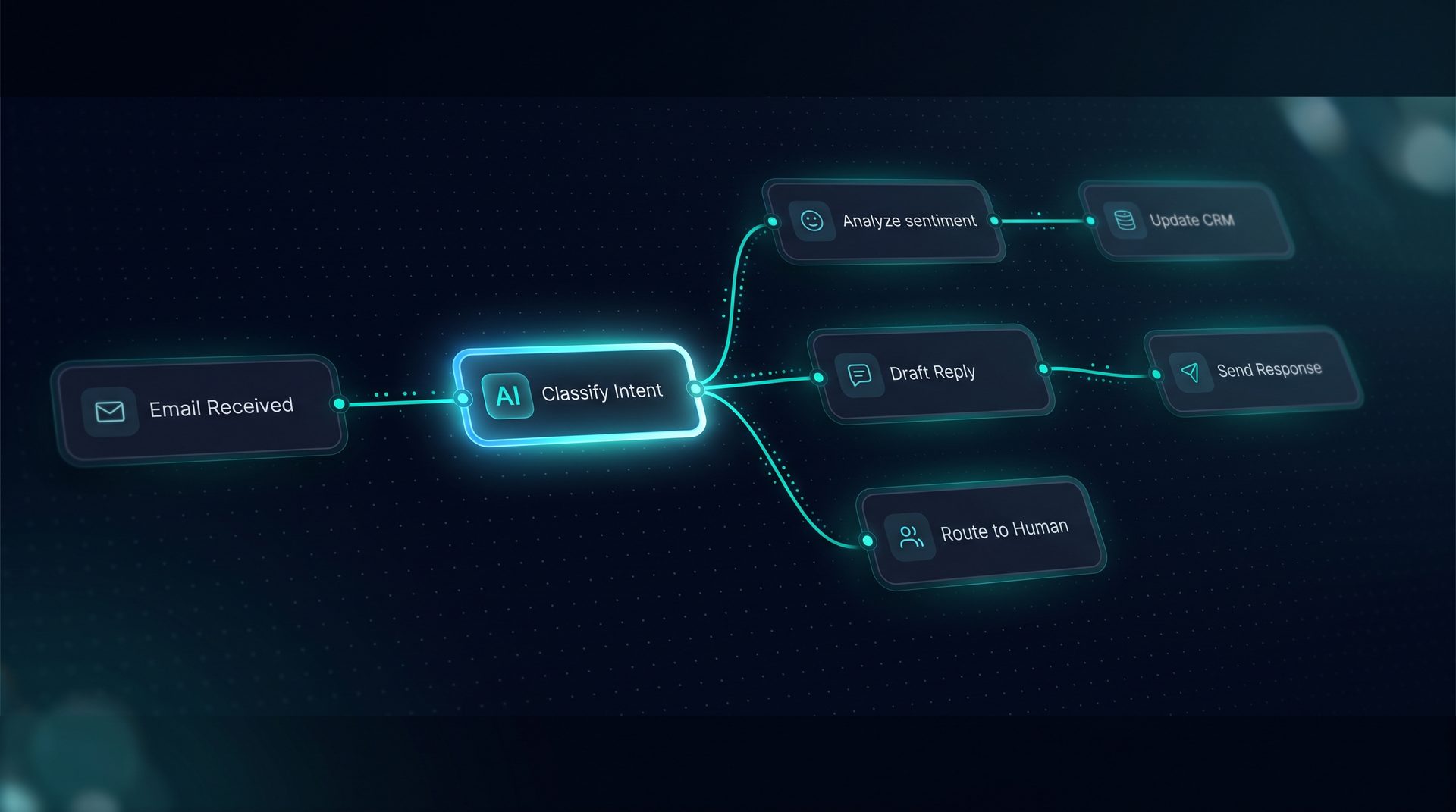
A supervisor acts like an orchestrator. It dispatches to multi agent setups, spawning subagents that each run a specialist task. In multi agent scenarios, the supervisor can fan-out in parallel and join results, enabling multi agents systems to operate efficiently.
Tools and integrations
Tool registration supports REST, GraphQL, SQL, MCP and built-in tools. Tools are testable live on the canvas and can be grouped into named sets and granted in one click. This reduces friction for non-developers while preserving security controls like retries, rate limits, caching, and environment-specific endpoints.
Knowledge and retrieval
In agent systems that rely on retrieval, ingest content from files, URLs, or crawled sites. Chunking and offline-capable embeddings store vectors in folders. Q&A pairs can intercept frequent questions before retrieval to increase precision and reduce cost per run.
Human-in-the-loop and governance
Use pause nodes for approvals and live handoff to route sessions to a human inbox. Project-level PII redaction, blocked terms, network allow/deny lists, budget caps, and audit logs apply across agents to meet compliance needs.
Who should use ai agent architecture
- Product teams building customer support workflows that require email triggers and web widgets.
- Ops teams automating approvals, data routing, and integrations without full-time developers.
- ML engineers and agent engineering leads designing multi agent topologies with observability and cost tracking.
Agent systems help organizations move from prototype prompts to robust production automation while keeping control over data and deployment environments.
When to choose this pattern
Choose ai agent architecture when:
- Workflows require conditional branching, parallelism, or human reviews.
- You need granular observability and per-step cost accounting.
- Multiple specialist capabilities must interoperate, such as retrieval + classification + API orchestration.
When you have simpler, single-turn tasks, a one-off model call may suffice. But as complexity grows, multi agent and multi agents systems reduce maintenance overhead.
Example: shipping a supervised multi agent workflow
- Create a Deep Agent as the supervisor with a clear system prompt.
- Drag subagent handles to attach specialist nodes for retrieval, transformation, and API calls.
- Register tools for external systems and apply JMESPath to trim payloads.
- Add a pause node for manual approvals and enable per-project redaction rules.
- Test in the Playground and inspect the span tree for latency and token cost.
This example shows how ai agent architecture converts an abstract process into deployable components that non-technical users can maintain.
Closing thoughts
Adopting ai agent architecture helps teams scale automation while retaining governance and observability. Agent engineering practices such as modular subagents, typed routing, and per-node inspection keep systems auditable and easier to iterate. When you need resilient, inspectable, and team-friendly automation, this architecture is a practical choice.
Key takeaway: Break complex workflows into a supervisor and specialist subagents, secure tool integrations, and monitor every run span-by-span to ship with confidence.