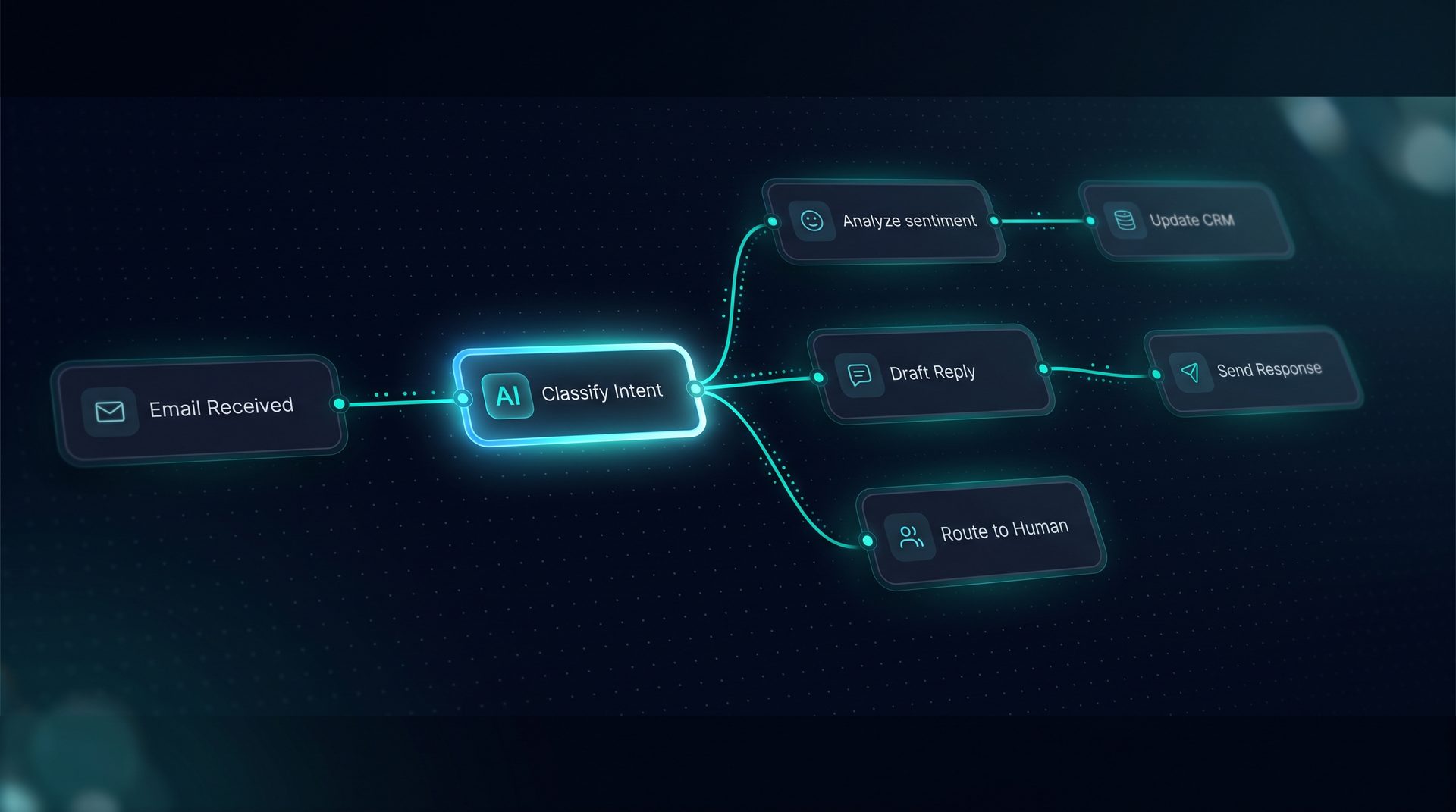
ai for enterprises
ai for enterprises has moved past prototypes. Larger organizations now focus less on flashy demos and more on governance, observability and cost control. This deep-dive explains the technical mechanisms, tradeoffs, and practical steps that make an enterprise AI program resilient and audit-ready. It also links this operational work to common enterprise concerns like ai for companies strategy, ai for it operations coordination, and platform choices such as an ai orchestration platform or ai automation platform.
Why governance and observability come first
When deploying ai for enterprises, the risk surface grows quickly: sensitive data flows, many model versions, and unpredictable costs. Early governance prevents data leakage and audit gaps; observability lets teams detect drift, bias signals, and runaway spend. Consider governance as the rulebook and observability as the instrument panel — both are required to keep an enterprise-scale AI program safe and useful.
Important to know: controls and monitoring can reduce risk but outcomes may vary by organization and use case. Policies and telemetry may need ongoing tuning as models and data evolve.
Key governance components
-
Data protection and PII redaction: Identify PII in inputs and outputs, apply redaction or tokenization, and record redaction decisions. For ai for enterprises, PII controls must operate at ingestion and inference, not just in training pipelines. Maintain clear logging of what was redacted and why.
-
Access controls and role-based policies: Define who can deploy, approve, or query models. Link access roles to audit logs to trace decisions and changes.
-
Audit logs and version history: Capture who deployed which model, configuration differences, and model artifacts. Version history should include model binary references, training data metadata, and evaluation artifacts.
-
Budget caps and cost governance: Enforce per-project spending limits, set quotas on API usage, and monitor compute and storage consumption. Cost control must be visible to both engineering and finance stakeholders.
-
Evaluation and review cycles: Establish repeatable evals that measure accuracy, fairness, latency, and safety. Track evaluation trends in observability dashboards.
Observability practices for enterprise AI
Observability in ai for enterprises focuses on telemetry that matters: input distributions, prediction confidence, latency, resource usage, and outcome metrics. Implement layered telemetry:
- Inference-level logs that include input and output hashes (not raw PII), confidence scores, and processing time.
- Model-level metrics: accuracy on labeled test sets, drift statistics vs baseline, and fairness metrics segmented by relevant cohorts.
- System metrics: GPU/CPU utilization, queue lengths, and cost burn rate per model or endpoint.
Use alerting thresholds for drift, error spikes, or unexpected cost acceleration. For ai for it operations teams, integrating these alerts with incident systems is crucial to ensure timely investigation.
Practical patterns: balancing privacy, auditability, and utility
Enterprises often face tradeoffs between strict PII redaction and model performance. Here are common patterns and their tradeoffs:
- Redact at ingestion: removes sensitive fields early, simplifying compliance but may reduce model signal.
- Tokenize and map later: store tokens and allow reversible mapping by authorized services; better utility but increases key management complexity.
- Synthetic data substitution: replace PII with realistic synthetic values for testing; reduces risk in non-production but requires rigorous controls to avoid leakage of sensitive patterns.
For auditability, capture derived data lineage: show which training data, preprocessing steps, and model version produced a given prediction. This lineage helps during compliance reviews and model investigations.
Cost control mechanisms that scale
Cost control goes beyond a one-off budget. Effective controls include:
- Per-endpoint quotas and throttling to prevent runaway inference costs.
- Scheduled autoscaling with floor/ceiling bounds to balance latency and spend.
- Rightsizing model choices: use smaller models for low-risk tasks and reserve larger models for high-value use cases.
- Chargeback or showback reporting that surfaces AI spend to product and finance teams.
Tie cost telemetry to observability dashboards so teams can correlate performance regressions with spend changes. In ai for companies programs, transparent cost allocation helps prioritise investments.
Version history and evaluation pipelines
A robust version history contains more than a model hash. It includes:
- Training dataset snapshot references and data schema versions.
- Preprocessing code and configuration.
- Model hyperparameters and training environment metadata.
- Evaluation artifacts: test sets, metrics, and failure examples.
Automate evaluation pipelines so every model version runs a standard battery of tests before promotion. These evals should cover utility metrics and safety checks, and be reproducible by auditors. For ai for enterprises, reproducible evals reduce friction in procurement and regulatory reviews.
Integration with ai orchestration platform and ai automation platform
An ai orchestration platform coordinates data ingestion, training, deployment, and monitoring. An ai automation platform focuses on automating repetitive pipelines and operational tasks. When choosing patterns for ai for enterprises, consider:
- How the orchestration platform exposes governance controls like policy gates and lineage metadata.
- Whether the automation platform supports policy-aware workflows that embed PII redaction and evaluation steps.
Practical integration patterns:
- Use orchestration to enforce pre-deployment checks: security scan, eval pass/fail, and cost estimation.
- Let automation handle routine retraining and metric collection, with human-in-the-loop approval for promotion.
Use cases and examples
- Customer support augmentation: deploy smaller, vetted models behind an access-controlled API; redact customer identifiers at input; log anonymized transcripts for quality monitoring.
- Financial decisioning: enforce strong audit logs and immutable version history; require dual approvals for model promotions; run fairness evals on protected cohorts.
- Internal search augmentation: keep a knowledge base ai index segmented by sensitivity; apply access controls and redact PII when returning results.
Each use case requires different guardrails. For instance, ai in data analysis pipelines can often tolerate reversible tokenization to retain analytic utility, while customer-facing chatbots typically need stricter redaction.
Operational rollout: how ai for it operations and business teams align
A staged rollout reduces risk and improves learning velocity. Typical phases:
- Sandbox: limited data, internal users, heavy telemetry, manual approvals.
- Pilot: small external user group, tightened governance, cost caps active.
- Production: full access with automated monitoring, formal audit trails, and finance-linked quota enforcement.
For ai for enterprises success, coordinate ai for it operations with business stakeholders. IT handles platform, security, and observability. Business teams define success metrics and acceptable risk levels. Regular reviews align both sides on tradeoffs and incident response.
Edge cases and failure modes to plan for
- Silent drift: model slowly degrades because input distributions change. Mitigation: scheduled drift checks and automated retrain triggers with human review.
- Cost spike from adversarial usage: public endpoints can be abused. Mitigation: rate limits, request-level budgets, and anomaly detection on usage patterns.
- Data lineage gaps: missing provenance makes audits hard. Mitigation: require metadata at every pipeline stage and reject artifacts that lack lineage.
Conclusion
ai for enterprises requires a systematic focus on governance, observability, and cost control before scaling use cases. Implementing PII redaction, audit logs, budget caps, version history, and repeatable evals creates an operational foundation that supports ai for companies initiatives and aligns ai for it operations with business goals. Thoughtful integration with an ai orchestration platform and ai automation platform can automate routine controls while preserving human oversight.
Notes: The effectiveness of controls and monitoring can vary with context. Organizations should treat these patterns as starting points and adapt them to their regulatory environment and operational constraints.
Further reading
Refer to sibling clusters on specific topics like model deployment patterns, data governance frameworks, and incident response for AI to continue building an enterprise-ready program.