ai for startups
If your team already understands the basics of adopting machine intelligence, this guide focuses on how to scope a first real agent without wasting a quarter. The phrase ai for startups appears here because choosing and delivering a compact, measurable agent is the difference between momentum and months of rework. This document explains mechanisms, tradeoffs, concrete selection heuristics for ai use cases, and practical steps to build, validate, and iterate a first agent that actually ships and creates customer value.
Why a focused first agent matters for ai for companies
Startups and small teams face three constraints: limited engineering capacity, limited time, and the need for early measurable outcomes. Picking one narrow agent lets a team learn the operational and product lessons of ai for companies with minimal exposure. A tightly scoped agent reduces integration complexity, makes evaluation straightforward, and shortens the loop between hypothesis and evidence.
Note: outcomes may vary by context. Results can depend on data quality, team experience, and customer fit, so treat early results as directional rather than guaranteed.
Core selection principle: impact over novelty
When choosing ai use cases, prioritize measurable impact rather than technical novelty. Agents that replace repetitive human steps, enable faster decisions, or reduce friction for core users deliver value faster than flashy but unvalidated features.
Key selection signals:
- Clear existing manual process to replace or augment
- High frequency or high cost tasks where small improvements compound
- Well-defined input-output structure (text, form, or structured data)
- Availability of modest labeled or unlabeled data to bootstrap models
Narrowing ai use cases into a single first agent
Use a three-filter process to refine candidates: feasibility, value, and learnability.
- Feasibility: Can the task be modeled with current resources and data? For many startups, tasks that map to retrieval, classification, or structured extraction are feasible.
- Value: Does automating or improving this task create visible savings or revenue levers? Prioritize tasks that directly affect conversion, retention, or cost.
- Learnability: Will building this agent produce reusable learnings for future ai for companies initiatives? Prefer tasks that teach about data pipelines, feedback loops, and user-facing UX.
Examples of good first agents for lean teams include:
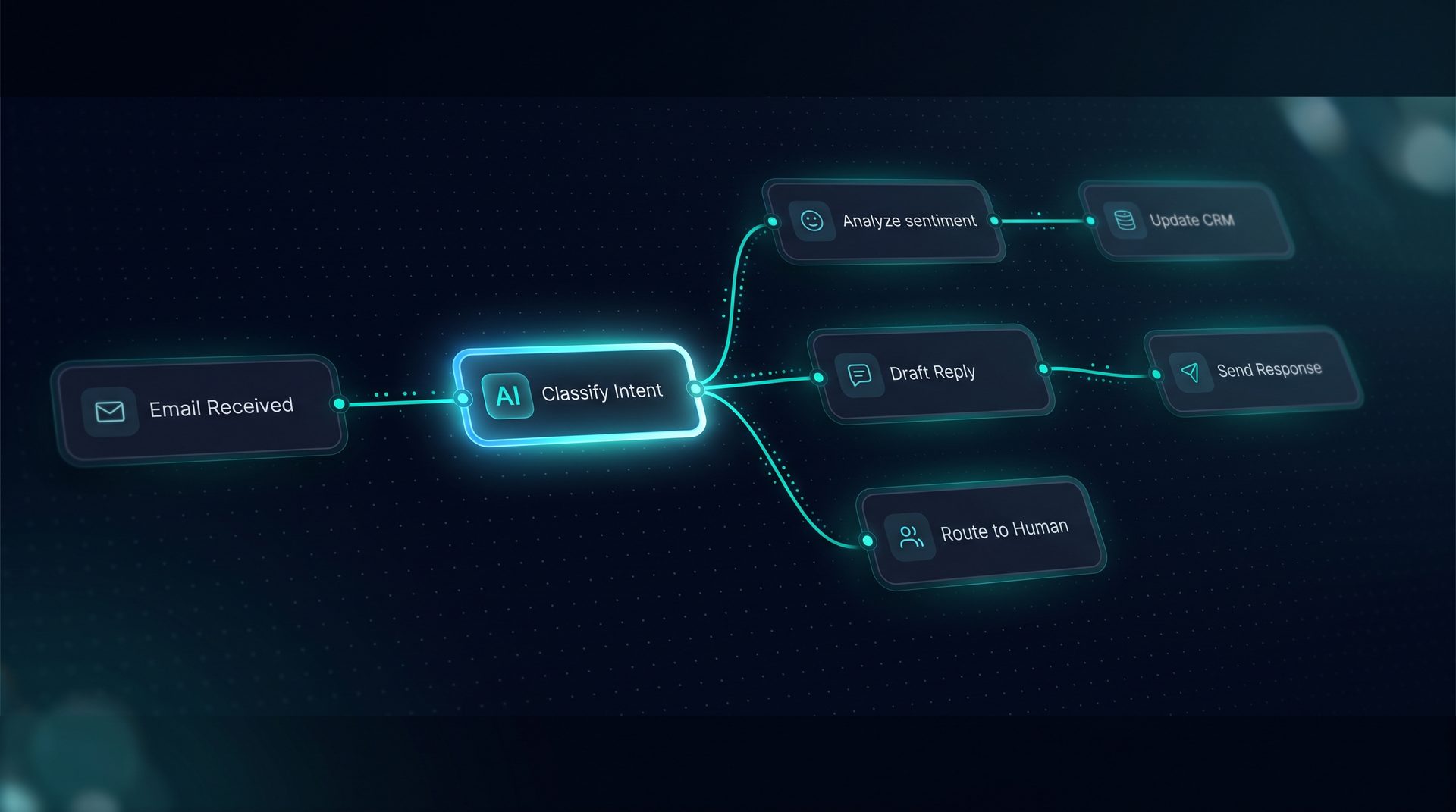
- An automated classification assistant that triages incoming requests
- A summarization agent that produces short actionable digests for users
- A data-extraction agent that turns uploaded documents into structured fields
Each of these maps to clear ai use cases and can often be validated with small labeled sets or weak supervision.
Building the agent: pragmatic architecture and steps
Step-by-step roadmap
- Define the hypothesis: state the specific user problem, expected improvement, and how success will be measured.
- Collect a minimal dataset: extract ~hundreds of examples where possible, or create synthetic labels that align with real user cases.
- Prototype a simple pipeline: focus on deterministic rules + lightweight model; avoid end-to-end complexity on first pass.
- Evaluate with real users: test the agent in a narrow live environment to capture qualitative and quantitative feedback.
- Iterate and harden: improve data quality, add monitoring, and plan a phased rollout.
Practical architecture tips:
- Use modular components: separate ingestion, model inference, post-processing, and logging so each is independently testable.
- Instrument everything: collect input distributions and error cases to prioritize labeling.
- Add a human-in-the-loop: keep a reviewer step early to prevent silent failures and to collect corrected labels.
Minimal viable agent patterns
- Classifier + override: model suggests a label, human confirms in the loop. This pattern reduces risk and collects labels for retraining.
- Retrieval + reranker: for information-heavy tasks, a retrieval layer with a small reranker often outperforms complex end-to-end generative systems for narrow domains.
- Extract-then-structure: for documents, extract fields with simple regex/NER fallbacks, then normalize.
Each pattern aligns with common use cases for ai for research, ai for automation, and ai automation examples found across lean teams.
Evaluation: metrics and experiments that matter
Choose a small set of metrics tied to the user or business outcome. Typical measures include task accuracy, time saved per transaction, reduction in human review volume, or change in conversion. For ai for startups, emphasize delta against baseline processes rather than absolute scores.
Suggested evaluation practices:
- Hold out a real-world validation set drawn from current traffic
- Track failure modes and categorize them (data, model, integration, UX)
- Run rapid A/B or canary tests in production to verify downstream effects
Handling edge cases and degradation
Edge cases will appear early. Triage them by frequency and impact: high-impact rare failures deserve conservative fallbacks; high-frequency minor errors are prioritized for model or rule fixes. Monitoring input distribution drift and user feedback helps detect when the agent needs retraining or constraints tightened.
Tradeoffs: speed, cost, and coverage
- Speed vs. accuracy: pushing for low-latency responses can increase error rates. For many first agents, a small delay with higher accuracy and human review is preferable.
- Cost vs. coverage: wide coverage often requires more compute and labeling. Start with the most valuable slice and expand.
- Automation depth vs. control: deeper automation can reduce costs but also hides failures. Maintain visibility through logs and human oversight during early rollouts.
These tradeoffs are central to ai for companies decisions and inform which ai use cases a small team should prioritize.
Practical example: scoping a customer support triage agent
- Hypothesis: an agent that assigns incoming tickets to the right team will reduce routing latency and free specialists for complex work.
- Feasibility: tickets are text-based and historically routed by humans; minimal labeled examples exist in support logs.
- Prototype: build a classifier that suggests a routing label and a confidence threshold that triggers human review below a set threshold.
- Evaluation: track correct routing rate, time to first action, and reviewer workload.
This example reflects classic ai automation examples where modest accuracy gains yield measurable operational improvements.
Governance and safety considerations
Even small agents can affect customer experience. Implement guardrails: confidence-based fallbacks to humans, transparency in the UI about automated suggestions, and an escalation path for unclear outcomes. These safeguards support responsible ai for research and deployment practices.
Conclusion
A focused first agent is the fastest path for ai for startups to generate useful, learnable results. Use the selection filters of feasibility, value, and learnability to find the right ai use cases, then build with conservative architecture patterns, human-in-the-loop safeguards, and tight evaluation. Early experiments may vary in outcome and should be treated as learning steps rather than guaranteed wins. Prioritize measurable impact, instrument aggressively, and expand coverage only after validating value.