Ai Use Cases That Survive Contact With Production
This deep-dive focuses on ai use cases that move beyond proofs of concept and survive contact with production realities. If you already understand basic definitions from the parent guide, this page concentrates on the specific mechanics, data requirements, human review points, evaluation metrics, and operational tradeoffs that determine which use cases for ai or use cases of ai actually ship and scale.
What Distinguishes Production-Ready Ai Use Cases
Production-ready ai use cases share several operational characteristics that differentiate them from demo bait. At a high level, these projects:
- Solve a narrowly scoped, repeatable decision or automation problem.
- Have available data that aligns with live inputs and is stable enough to train and validate models.
- Define clear human review or escalation points so the system degrades safely.
- Use success metrics that map to organisational outcomes rather than model-only scores.
Note: outcomes can vary by context. The examples and thresholds here are illustrative guidelines and may change depending on domain specifics and risk tolerance.
Core mechanism patterns
Most ai use cases that reach production map to a small set of mechanism patterns. Understanding these patterns helps teams select the right data and evaluation plan.
- Classification-based decisioning: Models map inputs to one of several discrete outcomes used to route work or trigger actions.
- Ranking and prioritisation: Models score items so downstream systems or humans act on the top-ranked subset.
- Extraction and structured conversion: Models convert unstructured text or images into structured fields for workflows.
- Generation with guardrails: Models produce text or content but operate behind validation, templates, and fixed scopes.
- Agent orchestration: Chains of smaller models or heuristics coordinate multi-step tasks, often with checkpoints.
These mechanisms are directly connected to common use cases for ai and use cases of ai across teams.
Examples: Concrete ai Use Cases That Ship
Below are practical, production-proven examples with the specific data, human review point, and success metric for each.
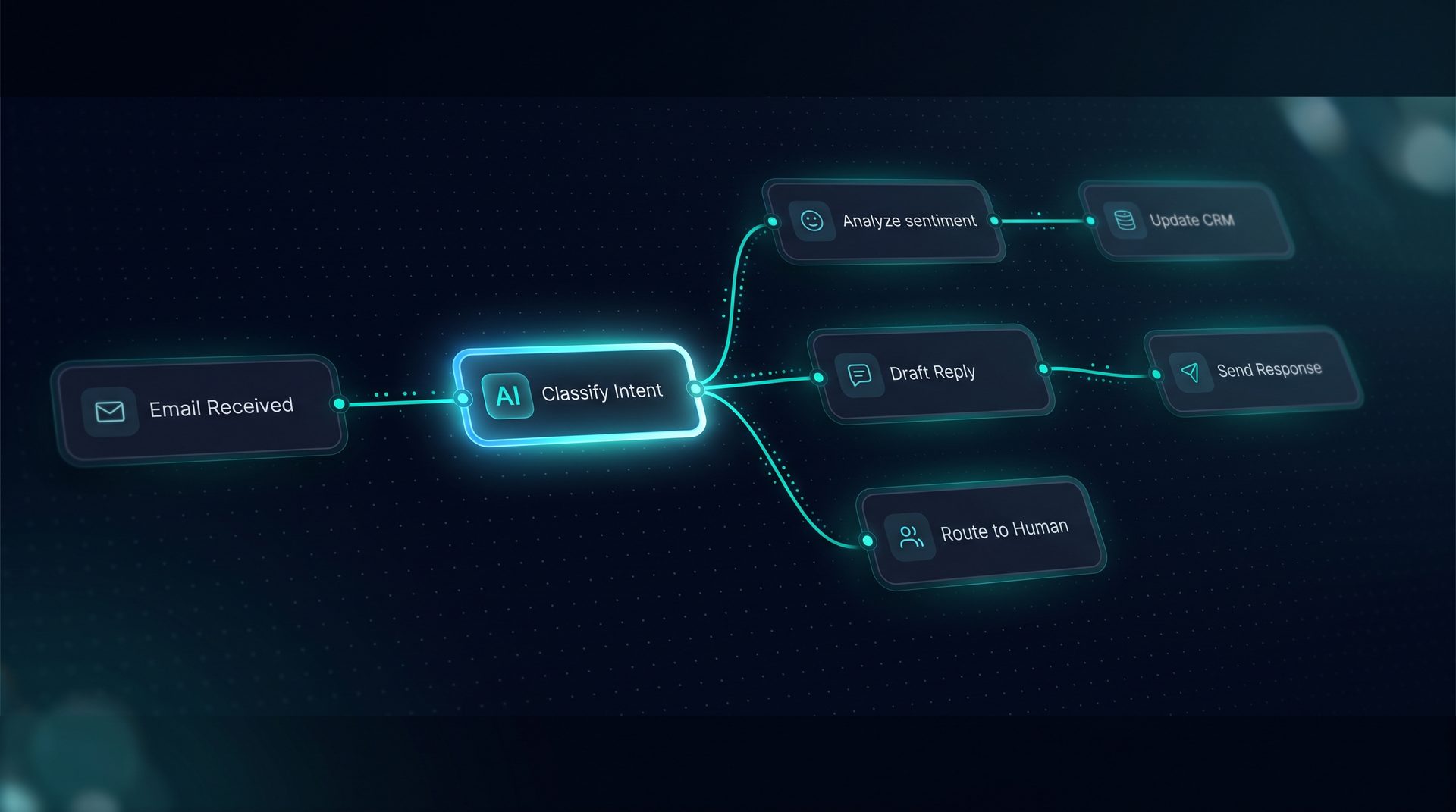
1) Triage and routing for support tickets (Classification-based decisioning)
- Data needed: historical ticket text, metadata (channel, product, customer tier), final routing labels, and any past override logs.
- Human review point: initial low-confidence predictions are tagged for human routing and corrections feed back into retraining.
- Success metric: reduction in average time to first action and increase in routing accuracy as measured against human-labeled holdout sets.
This use case often appears under use cases for ai in operations teams because it reduces manual queue work while preserving human oversight.
2) Prioritised incident alerts for IT operations (Ranking and prioritisation)
- Data needed: time-series telemetry, incident types, severity tags, historical escalations, and post-incident annotations.
- Human review point: present top-N alerts to on-call engineers with model confidence and explainability features; allow quick dismiss or escalate.
- Success metric: improved signal-to-noise ratio of alerts and faster mean time to acknowledgement for high-priority incidents.
This sits clearly in the ai for it operations category and benefits from explicit feedback loops from responders.
3) Contract clause extraction for legal workflows (Extraction and structured conversion)
- Data needed: annotated contracts with clause boundaries and labels, templates, and a corpus of negative examples.
- Human review point: model highlights extracted fields and suggests tags; lawyers verify and correct edge-case extractions.
- Success metric: time saved per contract review and reduction in missed clauses discovered during audits.
Extraction use cases of ai are high-value because they convert unstructured content into actionable data.
4) Drafting research summaries from academic literature (Generation with guardrails)
- Data needed: a curated corpus of research papers, citation metadata, and evaluation sets with human-written summaries.
- Human review point: every generated summary passes through subject-matter expert review for factual accuracy and citation checks.
- Success metric: reviewer time saved per literature search and quality rating against human summaries.
This is an example of ai for research where generation is useful but must be paired with expert validation to avoid hallucination.
5) Automated workflow agent that handles onboarding tasks (Agent orchestration)
- Data needed: structured onboarding steps, user attributes, historical completion logs, and API access patterns.
- Human review point: agents surface uncertain steps to HR or IT; routine tasks run unattended with audit logs.
- Success metric: decrease in manual task hours and increase in on-time onboarding completion.
Agent examples often combine small models with deterministic logic to produce robust outcomes in production.
Data Strategy: What Data Is Sufficient
A major failure mode is building models before verifying data alignment with production inputs. For each ai use case, check these conditions:
- Signal alignment: training data must reflect the same input distribution as live requests. If not, collect an initial stream of live samples.
- Label quality: labels used for supervised learning should include corrections and override histories rather than only final outcomes.
- Drift visibility: instrument features and raw inputs so drift can be detected when the model sees unfamiliar values.
Practical steps:
- Start with a small live shadow run to capture real inputs.
- Create a lightweight labeling workflow for ambiguous or high-impact examples.
- Maintain a holdout set drawn from recent production samples for evaluation.
Human Review: Where And How To Insert It
Human review prevents cascading failures and is the feature that turns risky prototypes into survivable production systems.
Common human review designs:
- Confidence gating: only low-confidence predictions surface to humans.
- Role-based escalation: route different error types to specialists or generalists depending on cost of error.
- Periodic audits: sample outputs regularly for quality scoring and calibration.
Design principles:
- Keep the human task minimal and focused to reduce fatigue.
- Capture corrections instantly as labelled data for retraining.
- Provide explainability hints so reviewers understand model rationales.
Success Metrics That Map To Outcomes
Avoid treating model accuracy as the only success metric. Choose metrics that connect to business or operational goals.
Examples:
- Time saved per user interaction.
- Reduction in manual handoffs or escalations.
- Increase in throughput of processed items without raising error rates.
- Improvement in downstream KPIs such as customer satisfaction or incident resolution time.
Measure both short-term model performance metrics and longer-term operational indicators to decide whether to expand or retire a use case.
Tradeoffs And Edge Cases
Every viable ai use case faces a set of tradeoffs:
- Automation vs. oversight: more automation reduces manual load but increases risk from unseen errors.
- Precision vs. recall: tuning for few false positives may increase false negatives; choose based on cost asymmetry.
- Complexity vs. maintainability: agent orchestration may solve complex tasks but increases operational surface area.
Edge cases to plan for:
- Distribution shifts when a new product version changes input patterns.
- Rare but high-impact events where the model has no training precedent.
- Latency constraints that force simpler models or precomputation.
Implementation Checklist For Shipping
- Validate data alignment with live inputs.
- Define human review gates and collect correction labels.
- Choose success metrics tied to operational outcomes.
- Instrument for drift, latency, and explainability.
- Run a shadow period with monitoring and rollback paths.
- Schedule periodic retraining and maintenance windows.
Conclusion
Successful ai use cases are those that pair a clear mechanism pattern with aligned data, a lightweight human review design, and success metrics that map to organisational outcomes. Use cases for ai and use cases of ai that survive contact with production are typically narrow, instrumented, and governed. Teams should prioritise projects where the data exists, the value is measurable, and human-in-the-loop points manage risk.
Important to know: results may vary by context and outcomes can change over time. Plans should include monitoring and the ability to adapt model scope and review points as live signals evolve.