AI for IT Operations
This article focuses on ai for it operations and how intelligent agents can reduce operational toil without introducing undue risk. The intent is practical: identify which ops tasks are appropriate for agents, compare ai for process automation versus automation with ai, and clarify what organisations should expect from an ai automation platform or an ai orchestration platform in an IT context.
Why ai for it operations matters now
ai for it operations is about using machine intelligence to handle routine monitoring, triage, and repetitive remediation so human teams can focus on higher-value work. In practice this means agents that observe telemetry, correlate events, and either suggest or execute actions. When assessing opportunities, teams should weigh operational risk, observability maturity, and how the ai integrates with existing change control.
Important to know: Results can vary by environment and configuration; outcomes may depend on data quality, policy settings, and human approval steps.
Which IT tasks suit ai agents (and which do not)
Suitable tasks:
- Repetitive remediation with well-defined rollback paths, such as restarting a hung service or clearing stale cache entries.
- Alert triage: grouping noisy alerts and surfacing probable root causes using correlation rules and ai in data analysis.
- Routine configuration checks and drift detection where changes are descriptive, not prescriptive.
- Log summarisation and anomaly highlighting to reduce analyst time spent scanning raw logs.
Unsuitable tasks without human oversight:
- Any change that affects sensitive configurations, network ACLs, or access policies should require explicit human approval.
- Complex architectural changes or capacity planning decisions that involve tradeoffs and business context.
- Actions that have irreversible impact on production data or user experience unless a tested rollback is guaranteed.
ai for process automation vs automation with ai
These two phrases are often used interchangeably, but they describe different design approaches.
ai for process automation
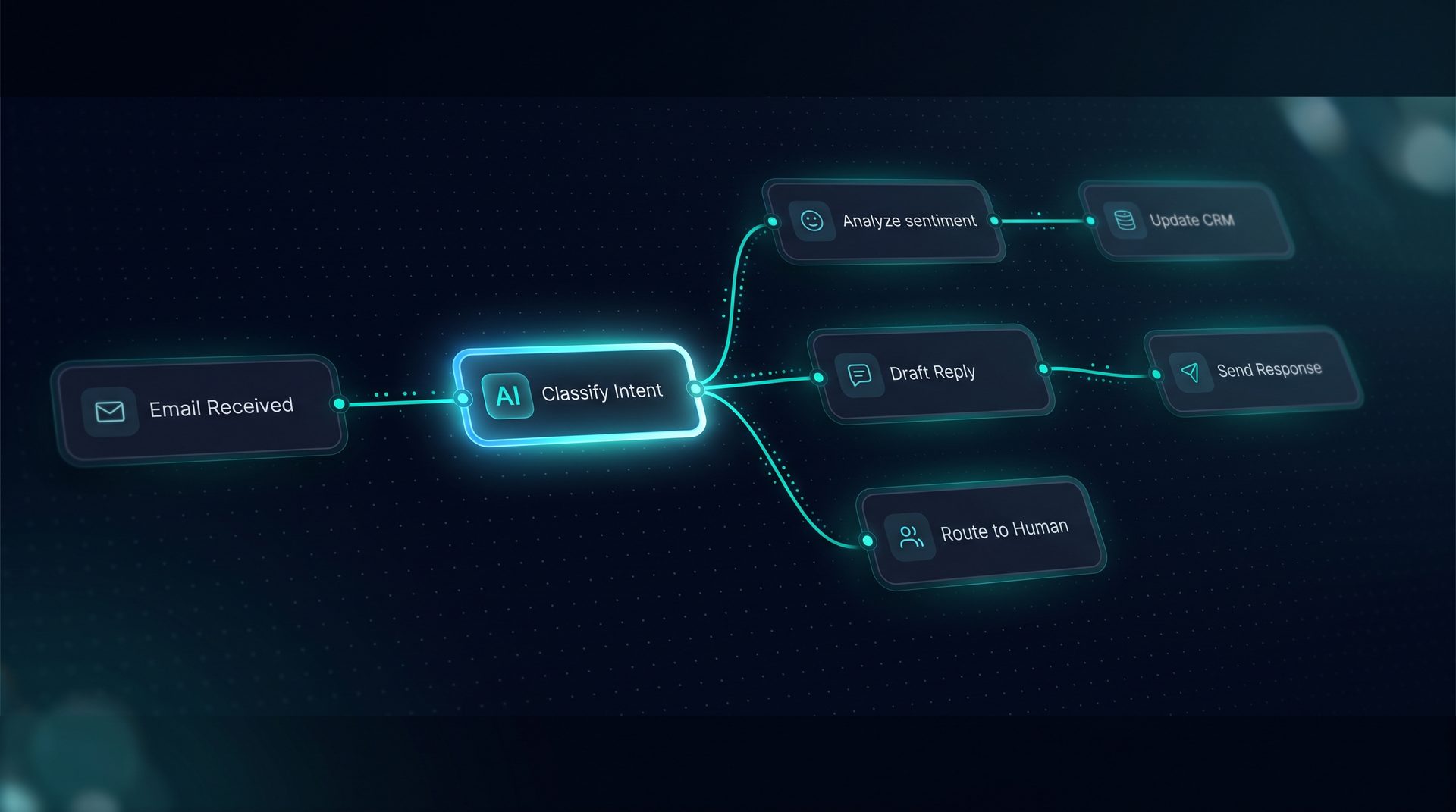
ai for process automation treats ai as the decision layer that defines what should happen next in a workflow. The ai inspects inputs, chooses among known remediation paths, and orchestrates tasks. This is useful where human reviewers would otherwise make repetitive, rules-based decisions. In IT operations, this often looks like automated incident routing, predictive maintenance triggers, and automated runbook selection.
automation with ai
automation with ai means using conventional automation tools enhanced by ai components for specific subtasks, such as using ai in data analysis to extract entities from logs, while the automation engine executes deterministic steps. This approach is more conservative: ai augments rather than controls the flow, which can reduce risk when organisations prefer clearer audit trails.
Tradeoffs
- ai for process automation can reduce human steps further but increases reliance on the ai decision logic and the need for robust validation and rollback.
- automation with ai keeps deterministic automation in control and limits ai to assistive roles, making it easier to satisfy compliance and change-control requirements.
Practical architecture: ai automation platform and ai orchestration platform roles
An ai automation platform typically provides components for model training, trigger management, and connectors to execute actions. It focuses on end-to-end automation where ai decisions drive outcomes. In contrast, an ai orchestration platform emphasises choreography across multiple systems and tools — it routes tasks, enforces policies, and provides visibility while optionally invoking ai components for decision support.
Key architectural principles:
- Clear separation of intent and action: ai should recommend or define intent; execution should pass through an auditable orchestration layer.
- Human-in-the-loop gates: for changes with user impact, the orchestration platform should enforce approval steps and provide context to approvers.
- Immutable change records: every automated action should produce structured logs that capture inputs, decisions, and execution artifacts for postmortem analysis.
- Scoped permissions: agents and automation connectors should run with least privilege and have constrained scopes to reduce blast radius.
Data and observability: feeding ai with useful signals
ai for automation and ai in data analysis depend on quality telemetry. Useful signals include event streams, structured logs, metrics, and change histories. Preprocessing steps such as normalization, enrichment, and time alignment are often required to make data usable for model inference. When data is noisy or incomplete, ai recommendations may be less reliable, so design must account for uncertainty and surface confidence levels to operators.
Example pipeline for anomaly-driven remediation
- Ingest metrics and logs into a centralized store.
- Run ai in data analysis to detect anomalies and group related events.
- Use an ai automation platform to map anomalies to candidate runbooks.
- Orchestration layer executes low-risk actions automatically and queues higher-risk changes for human approval.
- Record outcomes and feedback into the data store to refine future decisions.
Designing safe change workflows
To reduce risk when deploying ai for it operations, follow these practical controls:
- Require explicit approval for changes that affect production configuration or access controls.
- Implement progressive rollout: start with observational mode, then read-only suggestions, then automated execution for low-risk tasks.
- Maintain clear human override paths and immediate rollback procedures.
- Use canary or staging environments where possible to validate ai-driven actions before broad application.
Measuring success and evolving the system
Success metrics should combine technical health indicators with human-centric measures. Examples include mean time to acknowledge incidents, time saved on repetitive tasks, and operator satisfaction with ai suggestions. Use regular reviews to refine policies and retrain models with post-action outcomes so ai in data analysis improves over time.
Edge cases and failure modes
Consider these common failure modes:
- Data drift: telemetry sources change format or semantics, degrading ai performance.
- Overconfidence: agents act on low-confidence signals; mitigation is to surface confidence and require approval below a threshold.
- Cascading automation: multiple automated actions trigger each other unexpectedly; avoid by enforcing orchestration-level coordination and rate limits.
Implementation roadmap (practical steps)
- Inventory candidate tasks for ai for it operations by priority and risk.
- Establish telemetry foundations and validate data fidelity for ai in data analysis.
- Prototype with automation with ai: use ai for suggestions while automation executes deterministic steps.
- Introduce an ai orchestration platform to centralise workflow, approvals, and auditing.
- Expand to ai for process automation for well-understood, low-risk flows with rollback plans.
Conclusion
Adopting ai for it operations can substantially reduce operational toil while preserving safety when organisations apply clear design principles: keep human-in-the-loop for risky changes, use an ai automation platform and ai orchestration platform to separate decision and execution, and rely on robust observability and ai in data analysis to feed reliable signals. Start conservatively and iterate — the safest gains come from combining automation with ai and moving toward more autonomous workflows as confidence grows.