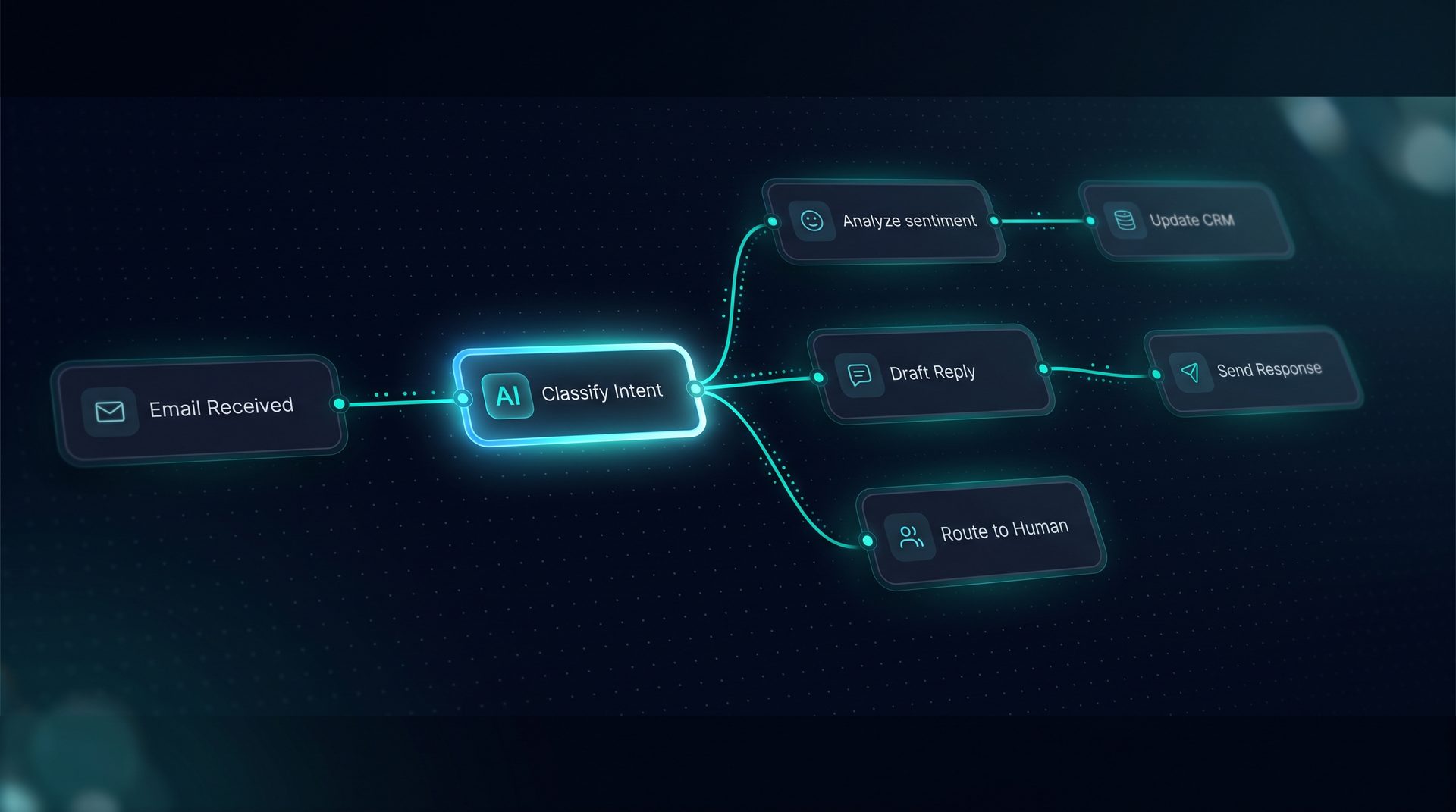
AI Automation: How AI Automation Software and Platforms Actually Work
AI automation is the practice of using machine intelligence to perform, assist, or augment tasks that historically relied on deterministic rules or human judgement. In the earliest paragraphs it helps to set expectations: ai automation can make decisions, infer context, and route work in ways rule-based automation cannot, but it also introduces probabilistic behavior and new design considerations. Understanding ai for automation, ai in automation, and how automation and ai combine is the starting point for designing reliable systems.
What "AI Automation" Means Today
AI automation describes an approach where models, inference pipelines, or agents participate in business processes. Unlike a purely rule-based script that follows explicit if/then logic, ai automation often uses patterns such as classification, extraction, ranking, and generation to interpret inputs and suggest outcomes. These AI-driven components are embedded inside a broader ai automation platform or delivered as ai automation software modules.
- Rule-based automation: deterministic, easy to reason about, limited when inputs vary.
- AI-driven automation: flexible with ambiguous inputs, requires monitoring and validation.
Important to know: results from ai automation may vary by data quality, model selection, and deployment context. Outcomes can improve with iteration but are not guaranteed to be identical across environments.
Core Sub-areas (This Map Guides Deeper Reading)
The topic splits naturally into a handful of cluster areas. Each area below is summarized so the reader can decide where to dive deeper.
AI Automation Software and AI Automation Platform
ai automation software refers to the components that perform inference, data transformation, and decisioning. An ai automation platform is the system that orchestrates those components into end-to-end processes, managing inputs, human review, retries, observability, and integrations. The platform perspective is essential because automation and ai combine not just at the model layer but across orchestration, security, and lifecycle management.
Why this matters: buyers and implementers must evaluate both the model capabilities and the platform controls that keep automation reliable.
AI Process Automation
ai process automation focuses on injecting AI into existing process flows — for example, automating document triage, routing approvals, or extracting structured data from unstructured sources. This area contrasts with traditional automation because it emphasizes uncertainty handling, confidence thresholds, and human-in-the-loop controls.
Key trade-offs: where rules fail due to variety, ai for automation can generalize—but it also requires monitoring and the right feedback loops.
AI Workflow Automation and Orchestration
ai workflow automation describes designing workflows that incorporate model calls, decisions, manual checkpoints, and error-handling. The orchestration aspect coordinates multiple agents or models and ensures the correct sequence of steps, retries, and compensations when failures occur. An ai orchestration platform is responsible for coordinating these elements at scale.
Design considerations include state management, observability, and clear escalation paths for ambiguous results.
AI Automation Examples and Patterns
ai in automation appears in many patterns: information extraction, classification and routing, assisted research, and automated synthesis. Understanding common patterns helps teams recognize opportunities and avoid projects that are unlikely to deliver value. Many successful patterns pair automated suggestions with human review rather than attempting full end-to-end autonomy.
How AI Differs From Traditional Automation
There are several structural differences that shape architecture and governance.
- Input variability: AI handles variability better than rigid rules but depends on representative training or prompt examples.
- Probabilistic output: outputs from ai automation are often ranked or scored rather than binary, which changes how failures are detected and mitigated.
- Feedback loops: automation and ai work best when decisions feed back to improve future outcomes through labels, human corrections, or active learning.
Practical implication: design processes that treat model outputs as suggestions when uncertainty is high and as actions when confidence is consistently strong and monitored.
Building Trust: Human-in-the-Loop And Observability
Trust is a primary barrier to adoption of ai for automation. Systems should offer:
- Human review gates where necessary, with clear UI for corrective actions.
- Audit trails showing why a model selected a particular outcome.
- Monitoring dashboards that surface drift, latency, and error rates.
Trust is built by predictable escalation paths and the ability to roll back or quarantine suspect outputs.
Integration Points And Deployment Models
ai automation systems connect to existing data sources, APIs, and workflow engines. Common integration points include document stores, ticketing systems, email, and databases. Deployment models range from tightly integrated platform deployments to lightweight model callouts inside existing automation engines. The choice depends on risk tolerance, latency needs, and the complexity of the process being automated.
Common Implementation Patterns
- Assistive automation: model suggests actions; humans approve.
- Autonomous automation with checks: model acts but triggers review if confidence is low.
- Hybrid orchestration: multiple models or agents collaborate, coordinated by an orchestration layer.
Choosing a pattern depends on domain risk, regulatory constraints, and the variability of inputs.
When To Prefer AI Process Automation
Consider ai process automation when tasks involve unstructured inputs, high variability, or require semantic understanding that would make rule creation brittle. If the process is highly repetitive and deterministic, traditional automation may be preferable. When adopting ai for automation, teams should pilot on bounded tasks, measure impact, and expand where monitoring shows stable performance.
Risks And Mitigations
AI introduces new operational risks. Practical mitigations include:
- Validation datasets for pre-deployment checks.
- Confidence thresholds and fallback logic to deterministic rules.
- Human review for edge cases and continuous labels for retraining.
These practices reduce the chance of harmful or incorrect automation outcomes and support recoverability.
How Platforms Support Lifecycle And Scale
An ai automation platform typically provides model management, workflow orchestration, connectors, versioning, and governance controls. Platforms make it easier to scale ai in automation by centralizing observability, enabling consistent rollout practices, and providing tools for human-in-the-loop workflows. However, not all platform claims are equal—teams should confirm what capabilities are present in practice rather than accepting generic descriptions.
Summary And Next Steps
AI automation changes how processes are designed by introducing probabilistic decisioning, human-in-the-loop patterns, and orchestration across models and services. Understanding ai for automation, ai in automation, and ai process automation is essential before adopting an ai automation platform or ai automation software. Start with a narrow, measurable pilot, instrument for observability, and design escalation paths that combine deterministic rules with model-driven insights.
Notes: implementation outcomes can vary depending on data quality, model choices, and operational practices. Results may improve over time but are not guaranteed and require active management.
Conclusion
ai automation is not a single technology but a set of design patterns and supporting systems that let machine intelligence augment and automate work. Properly understood, it can expand automation into areas traditional rules could not handle, while introducing new responsibilities for monitoring, governance, and human collaboration.