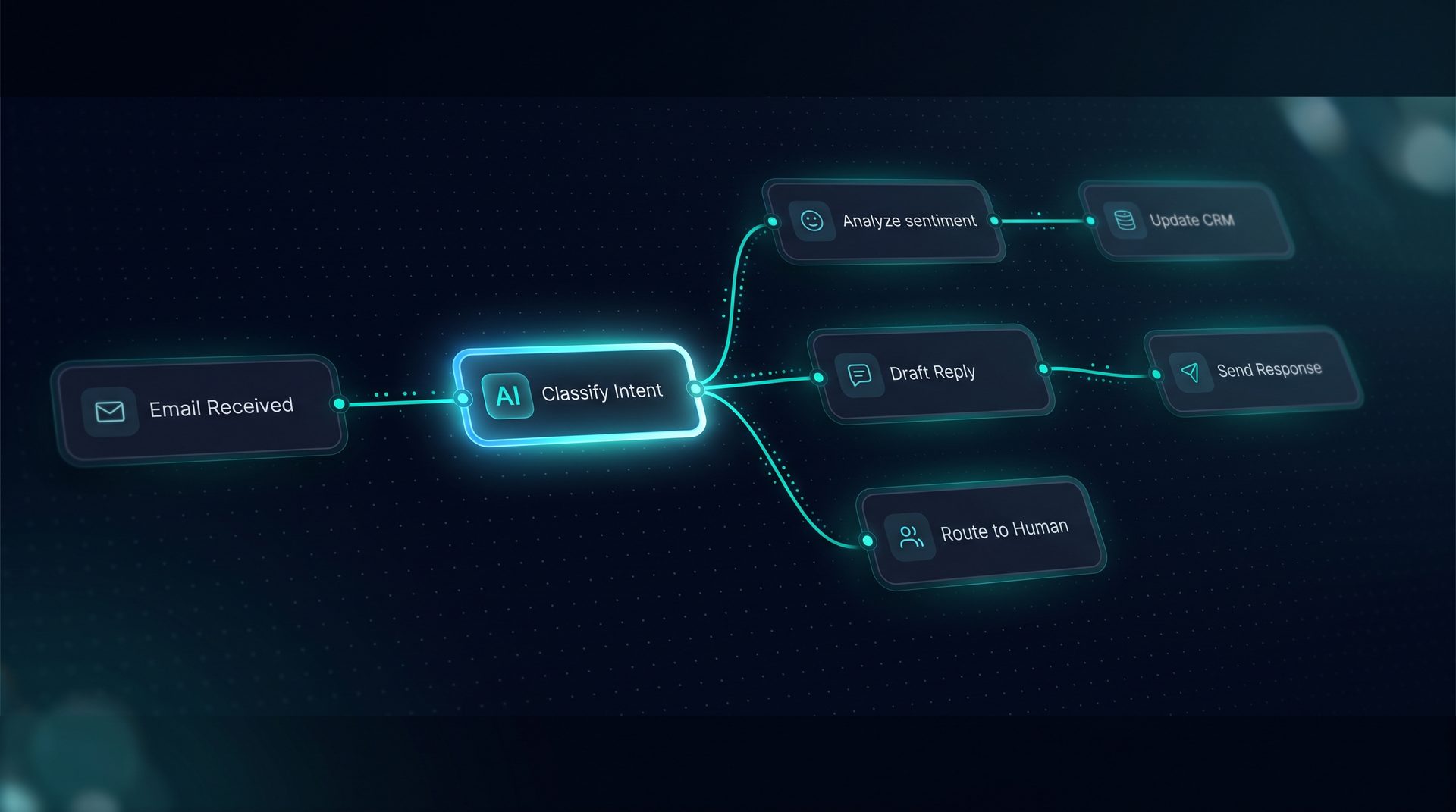
Ai Workflow Automation
Ai workflow automation focuses on coordinating AI tasks, human review, and system-level recovery so business processes behave predictably and audibly under real-world conditions. If the basic concepts of automation are familiar, this guide goes deeper into design patterns used by an ai workflow builder and visual ai builder to create trustworthy flows with clear state, retries, and observability.
What Makes Ai Workflow Automation Different From Scripts
Simple automation scripts often run in a single process with limited visibility and brittle failure handling. Ai workflow automation treats a workflow as an explicit state machine with checkpoints, retry policies, and human-in-the-loop steps. An ai workflow builder typically models each step as a discrete task with inputs, outputs, and well-defined transitions.
Key differentiators to expect:
- Explicit state tracking for each workflow instance so progress can be inspected.
- Human review tasks integrated as first-class steps, not ad-hoc pauses.
- Structured retry and error handling that separates transient from persistent failures.
- Pluggable orchestration of external services with timeout and compensation patterns.
These differences are what make an ai orchestration and automation platform suitable for business-critical processes where auditability and trust matter.
Core Design Patterns for Trustworthy AI Workflows
1. Stateful Steps and Live State Schemas
Design each workflow step to produce an explicit output schema. The schema should represent the minimal information needed for the next step and for auditing. A visual ai builder usually displays these schemas so designers can inspect the expected data shape.
Benefits:
- Easier debugging when a step fails because the last valid state is recorded.
- Clear contract between steps, reducing silent type or format errors.
Implementation notes:
- Define a compact state schema per step using simple types and clear field names.
- Log the state snapshot at step boundaries rather than only on errors.
- Store metadata like timestamps and actor (system or human) for traceability.
2. Human-In-The-Loop (HITL) as First-Class Flow Nodes
Treat human review as a normal step with timeouts, escalation, and versioned instructions. The ai workflow automation design should let a reviewer accept, modify, or reject outputs and propagate decisions into subsequent automated logic.
Practical patterns:
- Explicit review tasks with pre-populated context and suggested actions produced by an AI model.
- Time-based escalation where reviews escalate to a supervisor or alternate path after a timeout.
- Audit trail of reviewer comments and the exact inputs reviewed.
These patterns reduce ad-hoc manual interventions and make the human role repeatable and measurable.
3. Retry Patterns and Failure Handling
Rather than retrying blindly, distinguish between transient errors and deterministic failures. An ai orchestration platform should support backoff strategies, conditional retries, and compensation flows.
Common approaches:
- Exponential backoff for transient network or service errors.
- Circuit breaker to stop retrying a failing external dependency and route to fallback logic.
- Compensation steps to reverse effects of partially completed tasks if a subsequent step fails.
When designing retries, include maximum attempt counters and clear transition to human intervention after repeated failures.
4. Observability and Auditable Logs
Design workflows so every significant transition emits structured events. The ai workflow builder should record events that include step name, state snapshot, actor, and outcome.
Useful logging practices:
- Emit an event at step start and completion with the state schema.
- Capture model inputs and responses for AI-driven steps while considering privacy constraints.
- Index logs by workflow instance ID for quick retrieval.
These practices make it easier for operators to trace issues and for compliance teams to verify decisions.
Building Blocks Used by Visual AI Builders
A visual ai builder abstracts these building blocks as nodes and edges that a designer connects. Typical node types include:
- Task nodes (automated AI or code execution)
- Review nodes (human tasks with UI forms)
- Branch nodes (conditional logic based on state)
- Timer nodes (delays and timeouts)
- Error handler nodes (compensation and fallback)
By composing these nodes, designers can model complex business processes without embedding brittle logic in ad-hoc scripts. A good visual ai builder encourages small, testable nodes rather than long, monolithic flows.
Practical Example: Customer Document Verification Flow
This compact example illustrates how the patterns fit together. The goal: verify a submitted document and either approve, request more info, or escalate.
Flow outline:
- Ingest document and normalize into a state object.
- Run AI verification model to extract fields and confidence scores.
- Branch: if confidence is high, auto-approve; if medium, send to human review; if low, request resubmission.
- Human review node shows extracted fields, highlighted low-confidence areas, and suggested accept/reject actions.
- On reviewer accept, update state and trigger downstream provisioning; on reject, route back with reviewer comments.
- Log all steps and keep snapshots for audit.
Where retries and failure handling appear:
- If the AI verification model times out, retry with backoff and then route to human review if retries expire.
- If downstream provisioning fails after approval, trigger a compensation step to roll back any created resources and notify the reviewer.
This demonstrates how workflow automation tools can coordinate AI, humans, and systems safely.
Tradeoffs and Edge Cases
Every design choice involves tradeoffs. Here are common ones and how to think about them:
- Latency vs. Accuracy: Introducing human review increases latency but can improve accuracy for sensitive decisions. Use conditional review thresholds to balance.
- Visibility vs. Privacy: Storing detailed model inputs helps debugging but may expose sensitive data. Apply redaction and minimization strategies and store only needed fields.
- Complexity vs. Maintainability: Very granular node graphs are easier to test but harder to understand at a glance. Group related nodes into reusable subflows to keep diagrams readable.
Edge cases to prepare for:
- Partial failures where some external calls succeed and others fail—compensation steps are essential.
- State drift when schema changes—implement versioning and migration paths for instance state.
- Human unavailability—provide escalation and auto-decision policies for long-running reviews.
Integrations and Extensibility
An ai orchestration and automation platform should integrate with model runtimes, message queues, and identity systems. Important integration patterns:
- Use idempotent operations for external side effects so retries do not create duplicates.
- Authenticate human reviewers and attach identity to the audit trail.
- Emit workflow events to monitoring pipelines and error-tracking systems for proactive alerting.
Extensibility matters: designers should be able to add new node types or step templates as business needs evolve.
Notes On Real-World Guarantees
It is important to recognize that any ai workflow automation system can vary in behavior depending on model performance, system load, and human factors. Design choices can reduce risk and improve reliability, but outcomes may still vary. Use clear monitoring, human oversight, and versioned schemas to manage change over time.
Conclusion
Designing reliable ai workflow automation requires modeling state explicitly, treating human review as a first-class operation, and building robust retry and compensation strategies. A visual ai builder or ai workflow builder that enforces state contracts, observable events, and clear failure paths helps teams run complex processes with more trust and less surprise. Applying these patterns yields workflows that are auditable, debuggable, and resilient.
Important to know: workflow results can vary with model behavior, human decisions, and external service reliability; designs should expect variation and include fallbacks.