ai orchestration platform
This page is a focused, technical explanation of the ai orchestration platform concept: how systems coordinate multiple agents, tools, and models to complete complex tasks reliably and at scale. If you already understand basic automation or single-model integration, this article shows the concrete mechanisms, tradeoffs, and practical designs that distinguish ai orchestration from simpler workflow automation.
What "ai orchestration" means in practice
At its core, ai orchestration is the coordination layer that lets distinct AI agents, specialized tools, and different model types cooperate to achieve a higher-level objective. An ai orchestration platform organizes inputs, schedules actions, mediates information between agents, and ensures consistency when multiple autonomous components interact.
Key responsibilities in ai orchestration include:
- Task decomposition and routing — breaking a user request into subtasks and sending them to the right agent or model.
- State management — maintaining a shared view of conversation state, facts, and constraints across agents.
- Tool invocation and chaining — calling external tools or APIs, sequentially or in parallel, and consolidating outputs.
- Error handling and retries — detecting failures, deciding recoveries, and escalating when necessary.
- Policy enforcement — applying safety, privacy, and compliance rules across interactions.
This combination of responsibilities is what differentiates an ai orchestration platform from simpler ai automation platform features that run single-model or single-agent workflows.
Important to know: actual system behavior may vary by design and use case; orchestration components can be configured to favor speed, consistency, or robustness depending on requirements.
Components and mechanisms inside an ai orchestration platform
An effective ai orchestration platform is not a single monolith but a collection of cooperating subsystems. Below are the core parts and how they interact.
Orchestration engine (control plane)
The orchestration engine is the brain that schedules agent runs, triggers tools, and enforces sequencing. It typically offers:
- A declarative or programmatic way to define workflows and agent interactions.
- A scheduler that supports serial and parallel execution with dependency semantics.
- Hooks for conditional branching based on intermediate outputs.
In practice, the engine must be able to call both stateless models and stateful agents while preserving causal ordering and audit trails.
State and context store
Shared state is essential when multiple agents contribute to a single outcome. The state store holds:
- Conversation history and intermediate results.
- Structured facts and extracted entities for reuse.
- Provenance metadata to attribute outputs to specific agents or tools.
Good orchestration design keeps state modular and versioned so agents can operate on consistent snapshots.
Agent registry and role definitions
An ai orchestration platform manages a roster of agents and their capabilities. Each entry typically includes:
- Intent areas the agent handles (e.g., summarization, data retrieval, planning).
- Resource requirements and latency characteristics.
- Permission scopes and access to tools or data sources.
This registry enables dynamic routing and supports multi agent platform patterns where specialized agents collaborate.
Tool adapter layer
Tools range from simple functions (search, database queries) to external services (ticketing systems, analytics pipelines). The adapter layer standardizes calls and responses so the orchestration engine can chain them with minimal custom logic.
Observability and tracing
Tracing is essential to reconstruct how a final result was produced from multiple agents and tools. Useful observability features include:
- End-to-end traces showing sequence of agent calls and tool invocations.
- Logs enriched with context IDs and state snapshots.
- Metrics for latency, success/failure rates, and resource usage.
Policy and safety enforcement
Policy modules intercept requests and responses to ensure compliance with data handling rules and safety requirements. Policies can be applied at:
- Routing time (which agent can see what data).
- Execution time (sanitize inputs/outputs before tool calls).
- Aggregation time (redact or transform final outputs).
Patterns for coordinating agents and tools
Designing workflows in an ai orchestration platform relies on recurring coordination patterns. Recognizing these patterns helps decide when to use a multi agent platform approach versus a single-agent pipeline.
-
Pipeline chaining: a linear sequence where output from one model feeds the next. Useful for staged transforms like extraction → normalization → summarization.
-
Fan-out/fan-in: parallel agents perform different analyses on the same input and the results are merged. Common when combining diverse capabilities such as vision and language models.
-
Orchestrated debate: multiple agents propose solutions and a separate adjudicator agent ranks and selects the best. Helpful for higher-assurance decision making.
-
Tool-driven loops: agents call external tools and use the tool outputs to refine their next action, possibly iterating until a stopping condition is met.
Each pattern has tradeoffs in latency, consistency, and failure modes.
Tradeoffs and design choices
Choosing orchestration strategies requires balancing competing goals.
- Latency vs. thoroughness: Parallel fan-out can reduce time but increases complexity in merging conflicting results. Sequential pipelines are simpler but can add latency.
- Determinism vs. flexibility: Deterministic routing and fixed agent sequences make debugging easier; dynamic routing supports adaptive behavior but may make reproduction harder.
- Centralized vs. decentralized state: Central state simplifies cross-agent coordination; decentralized state can reduce contention but adds synchronization complexity.
- Resilience vs. cost: Aggressive retry and replication increase robustness but consume more compute and resource budget.
Practical examples and microflows
Below are concise examples to illustrate orchestration decisions.
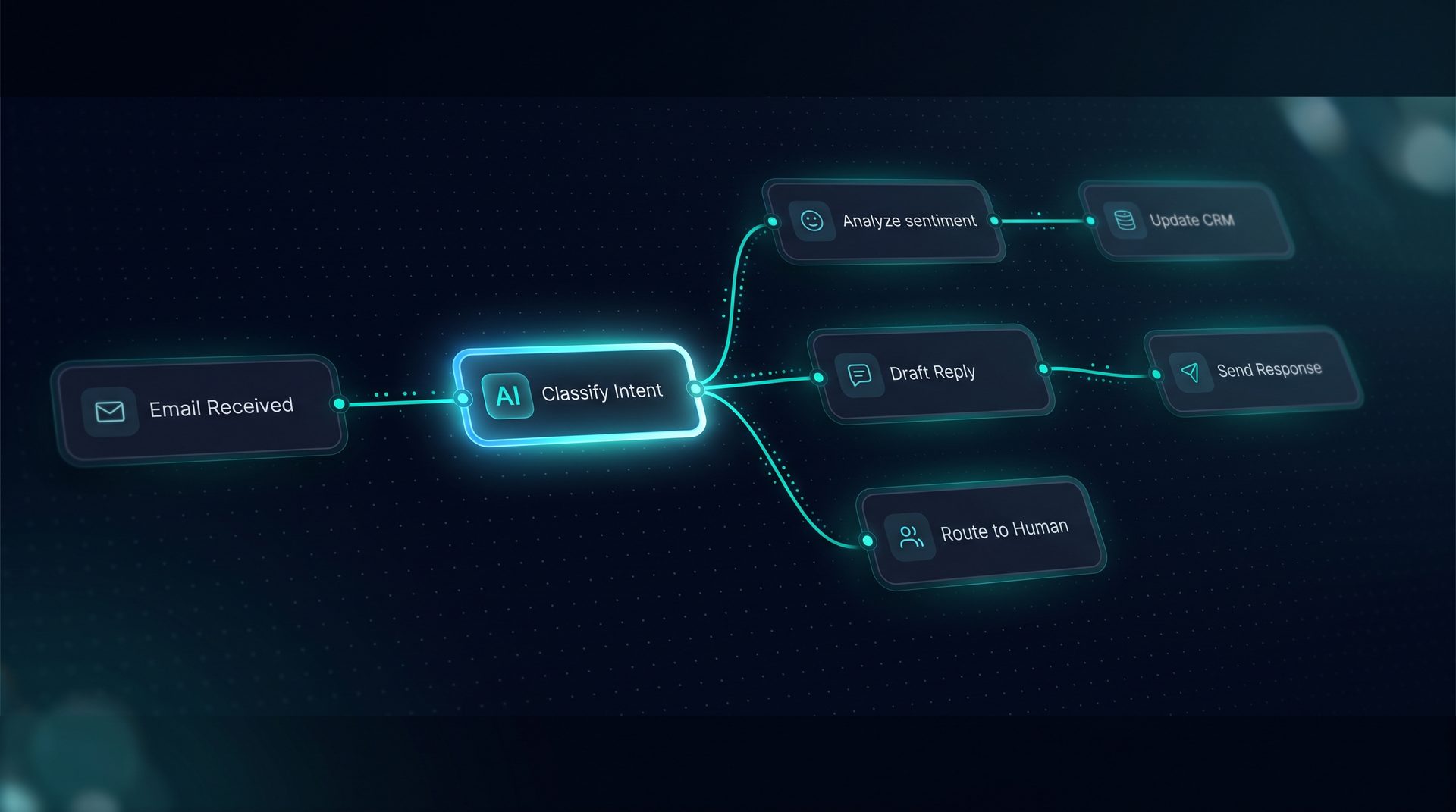
Example A — Customer request with data lookup and response generation:
- Ingest user message and classify intent.
- If intent requires data, route to a data retrieval agent that queries a database via a tool adapter.
- Normalize retrieved data in a transformation agent.
- Generate user-facing response using a language model agent that receives the normalized data and context.
- Apply policy filters before returning to the user.
Example B — Multi-step research task using multi agent platform approach:
- Planner agent decomposes research query into subtasks.
- Search agents run in parallel, each specialized on a data source.
- Extractor agents summarize findings and produce structured facts.
- Synthesizer agent merges facts and produces a coherent report.
- Quality-check agent validates citations and flags uncertain assertions.
These flows show how an ai orchestration and automation platform coordinates both agent automation and tool calls.
Edge cases and failure modes
Orchestration must anticipate and handle several difficult situations:
- Conflicting outputs: two agents return incompatible facts; resolution strategies include confidence scoring, adjudication agents, or human-in-the-loop review.
- Stale state: long-running tasks may operate on outdated snapshots; versioning and optimistic concurrency control mitigate this.
- Tool timeouts: fallback behaviors should be defined so downstream agents can proceed or surface meaningful errors.
- Policy conflicts: overlapping rules can block useful flows; clearly ordered policy evaluation helps manage conflicts.
When to choose an ai orchestration platform
Consider using a dedicated ai orchestration platform when your system requires:
- Multiple specialized agents or models to cooperate.
- Complex tool integration and conditional tool chaining.
- Auditable traces and provenance across multi-step tasks.
- Policy enforcement across different execution contexts.
If needs are limited to single-model pipelines or simple sequences, an ai automation platform with lightweight workflow features may suffice. For more sophisticated scenarios, a multi agent platform that supports agent automation and an ai agent builder workflow is more appropriate.
Conclusion
An ai orchestration platform is the coordination fabric that enables independent agents, models, and tools to act together reliably. It brings control-plane features like routing, state management, observability, and policy enforcement to the problem of composing AI capabilities. When designed with appropriate tradeoffs for latency, determinism, and resilience, orchestration unlocks complex, multi-step AI use cases that are difficult to achieve with one-off integrations.
Notes: implementations and behavior can vary by architecture and configuration; performance, guarantees, and exact capabilities may differ depending on the specific orchestration choices and deployment environment.