Ai Process Automation Vs Traditional Automation: Where Each One Fits
This deep-dive focuses on ai process automation and how it compares to traditional rule-based automation. If you already understand basic automation concepts, this article goes deeper into the mechanisms, patterns, design choices, and tradeoffs involved when introducing ai for process automation in real-world systems. The term ai process automation appears throughout to keep the discussion focused and practical.
What "ai process automation" specifically means
ai process automation describes automation that augments or replaces deterministic rules with models that infer, predict, or decide based on data. Instead of only executing explicit if/then rules, systems using automation with ai draw on learned behavior, probabilistic outputs, or natural language understanding to handle ambiguous or variable inputs.
Key mechanics that distinguish automation using ai:
- Statistical models that output probabilities or scores rather than boolean outcomes.
- Feature extraction pipelines that transform text, images, or time series into numeric inputs for models.
- Decision orchestration that combines model outputs with rules, thresholds, and human review.
Important to know: outcomes from ai and process automation can vary by data quality, model choices, and deployment context; results may improve over time or require adjustments.
When ai adds value over traditional automation
Use ai for process automation when deterministic rules fail to capture variability or when the cost of covering exceptions with rules is too high. Typical signals that ai may help include:
- High variability in inputs (free-text, scanned documents, images)
- Large volumes of exceptions that make rule maintenance expensive
- Need for prediction or prioritization (e.g., risk scoring, routing based on predicted urgency)
- Desire to extract structured data from unstructured sources
Examples where ai automation examples often appear include document classification, automated triage, and anomaly detection. ai for it operations is another common domain where models predict incidents or prioritize remediation steps based on historical telemetry.
Core patterns of ai and process automation
Below are practical patterns used when mixing ai into existing process flows.
Assistive Pattern
- Model provides a suggestion; a human approves or edits the suggestion.
- Use when the cost of an incorrect automated action is high and volume still justifies automation.
Augmentative Pattern
- Rules handle straightforward cases; model handles ambiguous or complex cases.
- This hybrid reduces risk while lowering workload on human reviewers.
Closed-loop Learning Pattern
- Model outputs are validated by users and the feedback is used to retrain or refine the model.
- Useful when labels can be collected cheaply during normal operations.
Autonomous Pattern
- Model makes decisions without human intervention, optionally with monitoring and rollback gates.
- Apply only when model reliability and governance meet organizational risk tolerance.
Designing an ai process automation project: practical steps
- Scope the process precisely: identify inputs, outputs, and decision points.
- Map current exception rates and maintenance effort for rules; estimate potential gains from automation with ai.
- Prototype with a minimal model for a narrow subtask (e.g., classification or extraction) before expanding to end-to-end automation.
- Define evaluation metrics that align with business goals (precision/recall tradeoffs, latency, human review rate).
- Select an orchestration design: assistive, augmentative, or autonomous.
- Build monitoring and alerting for model drift, performance degradation, and edge-case spikes.
- Plan for governance: explainability, audit logs, and rollback procedures.
Practical considerations for integration
- Data ingestion: ensure the feature pipeline mirrors training transformations used in development.
- Latency: some automation workflows require near-real-time responses; model choices and serving architecture must reflect that.
- Confidence thresholds: map model probability outputs into actions (auto-accept, escalate, require review).
- Human-in-the-loop interfaces: design UIs that make model intent and confidence obvious to reviewers.
Tradeoffs: what you gain and what you give up
- Maintainability: automation with ai can reduce the need to write brittle rules but requires data and model lifecycle management.
- Predictability: rule-based automation is deterministic and predictable; ai introduces probabilistic behavior that must be managed.
- Coverage vs accuracy: ai often increases coverage for messy inputs while trading off some interpretability.
- Cost profile: upfront costs shift from rule engineering to data labeling, model training, and monitoring, though long-term maintenance may be lower in variable environments.
ai for it operations: a focused example
In ai for it operations, models predict likely incident causes, prioritize alerts, or recommend remediation steps from historical telemetry. The pattern commonly used is augmentative: rules route obvious incidents while models score ambiguous signals and suggest likely root causes. This reduces analyst fatigue and focuses human time on novel problems.
Practical tips for ai and process automation in this domain:
- Use time-series feature engineering that captures trends and anomalies.
- Combine model outputs with existing runbooks and automation playbooks to automate safe remediations.
- Monitor feedback loops to detect changes in system behavior that degrade model performance.
Common edge cases and how to handle them
- Rare events: rely on fallback rules and human review when model confidence is low.
- Concept drift: schedule periodic retraining and use monitoring to detect drift early.
- Regulatory or audit requirements: maintain explainability artifacts and decision logs tied to each automated action.
Evaluating success: metrics that matter
- Reduction in manual throughput time or queue length.
- Change in false positive and false negative rates relative to business costs.
- Human review rate and reviewer correction rate.
- Business outcome measures such as increased throughput or reduced mean time to resolution.
Notes: Implementation results can vary depending on data, domain, and governance; improvements may take time and require iterative tuning.
Practical ai automation examples to learn from
- Document ingestion: models extract key fields from invoices and feed structured data into downstream systems.
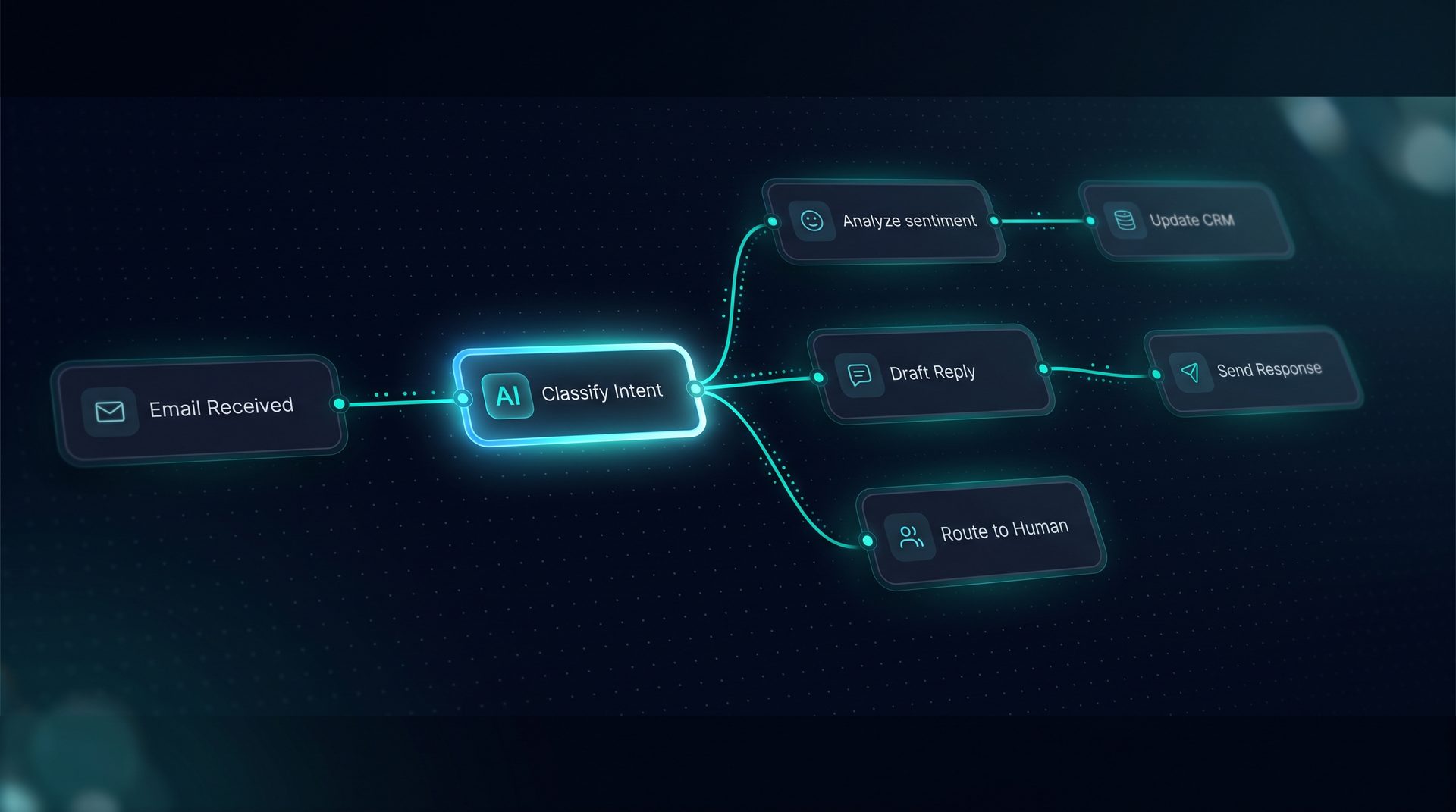
- Email or ticket triage: classification models route incoming items to the correct team.
- Prioritization: scoring models rank tasks by predicted urgency or impact.
Each ai automation example typically pairs an initial model with rules for confidence gating and human review.
Conclusion
Bringing ai into process automation shifts the design from purely deterministic flows to probabilistic, data-driven systems. ai process automation is most valuable when inputs are variable, exceptions are frequent, or predictions add measurable value. Use hybrid patterns (assistive, augmentative) to manage risk, instrument monitoring and governance carefully, and plan for an iterative lifecycle of model improvement and process tuning. When done thoughtfully, automation using ai can extend automation coverage and reduce manual effort while requiring new operational practices to manage model behavior.