ai agent architecture
This deep-dive explains ai agent architecture for readers who already understand basic machine learning and language model concepts. In the next sections, the guide breaks down how an agent differs from chains, how tools and memory attach to agents, how orchestration and multi-agent ai patterns work, and where agent based ai and autonomous agent designs are most appropriate. The primary goal is to clarify the mental models and concrete tradeoffs you will face when designing agent systems.
What "agent" means in system architecture
An agent is a component that perceives inputs, maintains internal state, decides on actions, and executes those actions. In ai agent architecture the decision loop is explicit: sense, reason, plan, act, and record. That loop contrasts with a single-model pipeline or chains of prompt->response steps because agents incorporate ongoing state and can call external capabilities.
Key properties of agent based ai designs:
- Persistent or session-scoped memory that influences behavior across steps
- Ability to call external tools (APIs, databases, search) as part of reasoning
- An explicit orchestration layer that schedules work and handles failures
- Decision-making that may involve planning, subtask decomposition, and iterative refinement
Note: practical outcomes can vary and results may depend on model capability, tool latency, and design choices. The patterns below help reason about tradeoffs rather than guarantee specific performance.
Core building blocks of ai agent architecture
Perception and input handling
Agents accept structured and unstructured inputs: natural language prompts, sensor streams, or preprocessed data. Effective input handling includes normalization, intent classification, and context enrichment before reasoning.
Reasoning and policy
Within ai agent architecture the reasoning component can be a single large model invocation or a hybrid of symbolic logic and learned heuristics. The policy defines how the agent chooses actions: deterministic rules, scoring functions, or probabilistic exploration.
Tools and capability attachments
Tools are external capabilities agents call to extend their reach. Examples include data retrieval, calculators, file operations, or domain-specific APIs. Integrating tools requires:
- A capability registry describing inputs/outputs
- Call protocols and error handling
- Security constraints and access control
Tools change the nature of agent systems: an agent that can query a database or execute commands behaves very differently than a model-only chain.
Memory and knowledge
Memory in agent based ai can be ephemeral (session-only) or persistent (cross-session). Memory types include:
- Short-term working memory used within a single plan
- Episodic memory recording past interactions
- Semantic memory storing extracted facts or embeddings for retrieval
Memory retrieval strategies are crucial: naive inclusion of long memory can overwhelm context windows, while too aggressive summarization can lose detail. Hybrid retrieval — selective retrieval based on relevance signals — is a common pattern.
Orchestration and control flow
Ai orchestration coordinates the pieces: model calls, tool invocations, memory reads/writes, and task scheduling. Orchestration responsibilities include:
- Sequencing actions and sub-tasks
- Monitoring tool responses and retrying when necessary
- Handling parallelism or task delegation across agents
- Logging and observability for debugging and auditing
Orchestration is distinct from the agent's internal policy: it implements the execution environment and runtime rules the agent operates within.
Agent vs chain: a focused comparison
Chains are linear or branched sequences of model calls or transformations where each step produces the next step's input. In contrast, ai agent architecture is centered on an active decision loop that can call chains as tools. The practical differences are:
- Chains: predictable linear control flow, simpler debugging, limited context retention beyond the chain
- Agents: flexible control flow, richer state and memory, ability to call tools and retry, higher complexity in debugging and safety
Choosing between the two depends on task complexity: chains suit well-structured pipelines; agent systems shine when tasks require planning, tool orchestration, or long-horizon memory.
Multi agent ai and collaboration patterns
Multi agent ai refers to systems where multiple agents interact, coordinate, or compete to achieve goals. Architectures vary by coupling and communication mode:
- Centralized orchestration with multiple worker agents
- Peer-to-peer communication with negotiation protocols
- Hierarchical coordination where a manager agent delegates to specialists
Design decisions include message formats, synchronization strategy, and conflict resolution. Multi agent ai can improve robustness and modularity but increases the need for protocols and observability.
Examples of multi-agent patterns
- Task decomposition: a planner agent splits a complex job into subtasks and dispatches them to specialist agents
- Pipeline specialization: agents implement different stages (retrieval, validation, generation) and pass artifacts
- Competitive selection: multiple agents propose solutions and a comparator agent selects the best
Each pattern has tradeoffs in latency, throughput, and difficulty of debugging.
Designing tools and tool invocation patterns
Tool design in ai agent architecture should emphasize clear contracts. Typical patterns:
- Synchronous tools for quick lookup or computation
- Asynchronous tools for long-running tasks with callback or polling
- Composite tools that internally orchestrate multiple low-level capabilities
When an agent invokes a tool, include fallback plans for failures and timeouts. Design decisions around atomicity and idempotency of tool calls affect reliability.
Memory strategies and retrieval-augmented reasoning
Retrieval-augmented approaches let agents access large knowledge stores without expanding context windows. Key patterns:
- Embed-and-retrieve: store embeddings of documents or interactions and fetch nearest neighbors
- Indexed summaries: keep concise representations with pointers to full context
- Hybrid caching: store frequently used facts in a fast-access working memory
Balancing relevance, recency, and cost is an engineering challenge; retrieval frequency and summarization policy shape performance.
Safety, governance, and observability considerations
Agent systems introduce new attack surfaces and governance needs. Consider:
- Permissioning for tool access to prevent harmful operations
- Audit trails for decisions, tool calls, and memory writes
- Rate limits and throttles to protect external systems
- Explainability: recording rationale or intermediate steps for post-hoc review
Observability in ai agent architecture requires structured logs and traces that link agent decisions to tool responses and memory state.
When to choose agent based ai or autonomous agent designs
Agent based ai and autonomous agent designs are most appropriate when tasks require planning, tool integration, or long-term state. Use cases that favor agents:
- Complex workflows with conditional branching
- Tasks requiring dynamic access to external knowledge or control
- Environments where continuous adaptation to new data is needed
For straightforward text transformation or static pipelines, chains may be simpler and easier to maintain.
ai agents examples and concrete scenarios
- A research assistant that iteratively searches, reads, and synthesizes literature by calling search tools and a note store
- An automation agent that monitors incoming requests, queries internal systems, executes safe operations, and records outcomes
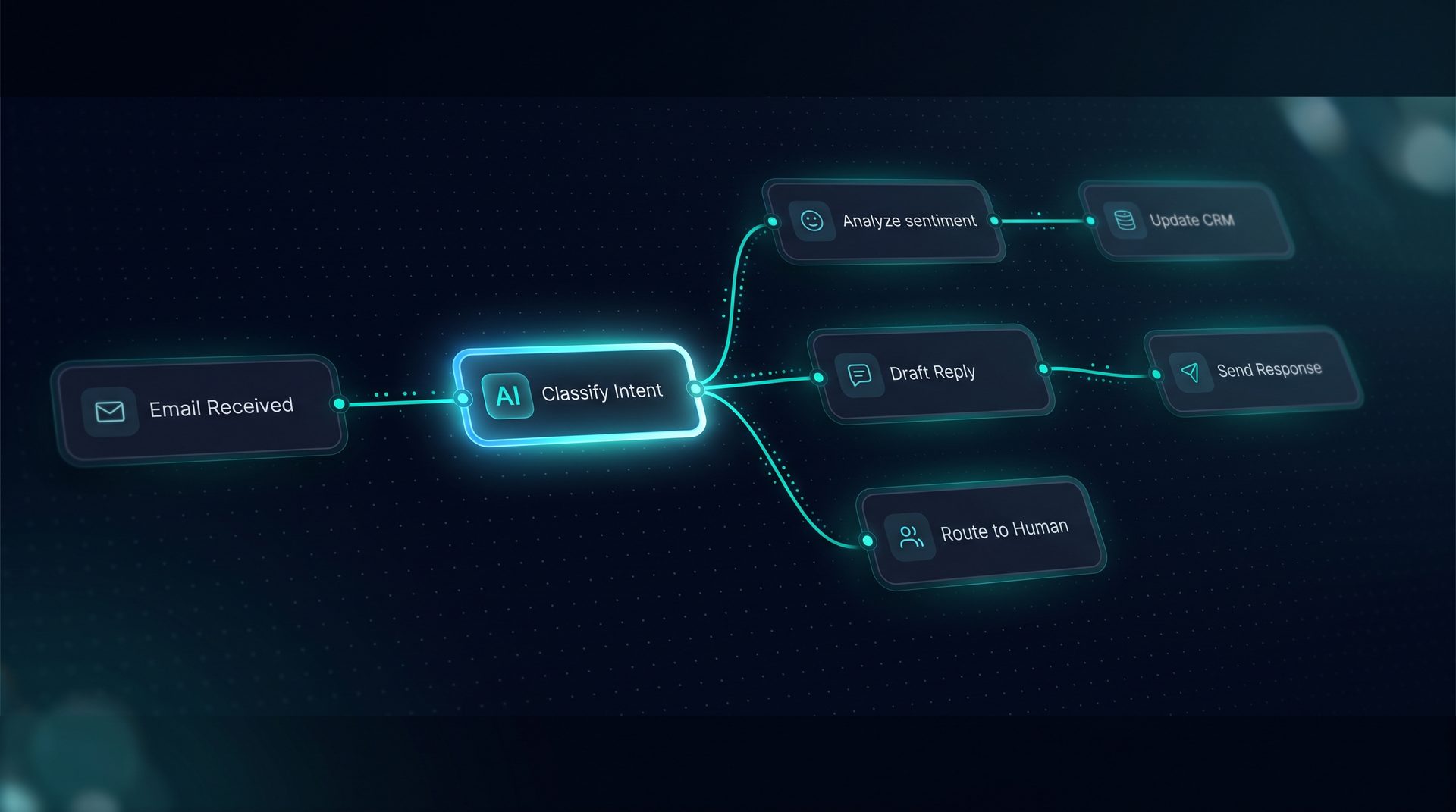
- A customer support coordinator that retrieves account history, drafts replies, and escalates to human agents
Each example highlights different parts of the ai agent architecture: tools, memory, orchestration, and multi-agent coordination.
Practical tradeoffs and engineering tips
- Start simple: prototype with a single agent and a small set of tools before adding multi-agent complexity
- Design clear tool contracts and test error modes deliberately
- Keep memory selective; prefer concise summaries and relevance filtering
- Add observability early; tracing decisions to tool calls is crucial for debugging
Important to know: outcomes from any agent design may vary depending on model capabilities, latency, and data quality. Designs that work well in one setting can need significant tuning in another.
Conclusion
ai agent architecture organizes systems around active decision loops that use tools, memory, and orchestration to handle complex tasks. Understanding the distinctions between agents and chains, and choosing appropriate memory, tool, and orchestration patterns, provides a practical roadmap for when to adopt agent based ai or multi agent ai approaches. Thoughtful design of interfaces, fallback behaviors, and observability helps keep systems maintainable and safer over time.