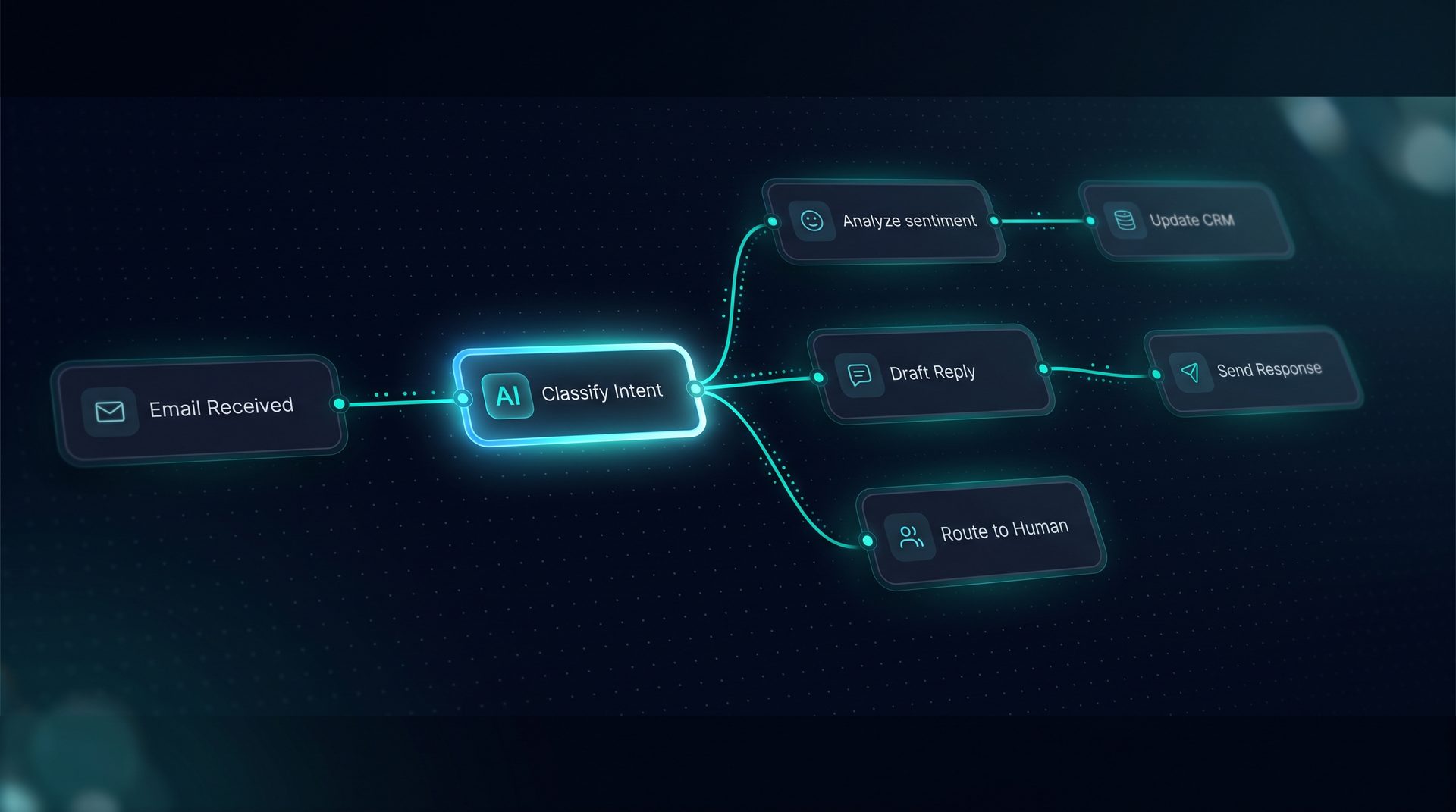
Agent Automation
Agent automation turns high-level goals and natural-language prompts into sequences of actions performed by an autonomous agent inside an agent platform. This page focuses on the decision points that determine whether agent automation should replace traditional hard-coded scripts, and why agent systems sometimes add cost or brittleness instead of removing it. If you already understand basic scripting, this deep-dive explains how agent engineering changes reliability, cost, and scope.
How agent automation differs from scripts
Scripts are deterministic sequences: input maps to a defined sequence of steps and outputs. Agent automation uses an autonomous agent that interprets goals, plans sub-tasks, and often calls external tools via an agent platform. Key differences:
- Flexibility: agent systems can handle ambiguous input and adapt flow at runtime; scripts cannot deviate without explicit branches.
- Error handling: agents can attempt retries, replan, or ask clarifying questions; scripted flows require manual branching for each anticipated error.
- Integration surface: an autonomous agent can orchestrate multiple APIs and tools dynamically; scripts are typically hard-wired to specific endpoints.
Agents excel when the space of valid behaviors is large or ill-defined; scripts excel when every step can be precisely enumerated.
When agent automation wins
Agent automation tends to be the better choice when:
- Requirements are fuzzy or change frequently. Agent systems let users express intent rather than exact steps.
- Workflows must integrate many heterogenous tools and services dynamically — an agent platform can discover and sequence tool calls.
- Human-like reasoning or classification under uncertainty is required, such as summarization, document extraction, or conversational troubleshooting.
- You want rapid prototyping: agents can be iterated by changing prompts or reasoning heuristics without rewriting flow control.
When scripts remain preferable
Scripts are typically better when:
- The process is safety-critical and must be auditable line-by-line.
- Latency and predictable resource usage are primary constraints.
- Behavior must be consistent and reproducible for compliance or regression testing.
- The task is simple and the overhead of running an autonomous agent would be more expensive than the value of flexibility.
Practical tradeoffs: reliability, cost, and observability
Agent engineering choices influence three operational axes.
Reliability
Agent automation offers dynamic recovery strategies but also introduces nondeterminism. Typical reliability considerations:
- Model reasoning can produce unexpected plans; engineering mitigations include constrained tool catalogs, plan validators, and conservative prompts.
- When exact outcomes are required, add verification steps after agent actions to compare results against expected invariants.
- Use synthetic tests and scenario-based evaluations to probe agent behavior across edge cases.
Cost
Running an autonomous agent often uses model compute and additional middleware in an agent platform. Cost tradeoffs include:
- Pay-for-flexibility: agents may reduce engineering hours but increase run-time compute and orchestration costs.
- Scripts have lower runtime cost but higher maintenance when requirements shift.
Observability and auditability
Understanding what an agent did can be harder than inspecting a script. Improve transparency by:
- Logging agent plans, tool calls, inputs, and outputs in structured form.
- Adding deterministic checkpoints where the agent must await human or programmatic approval.
- Recording decision traces for postmortem analysis.
Designing agent engineering patterns for stability
Agent engineering is the practice of shaping an autonomous agent’s prompts, plan structures, and tool interactions for consistent operation inside an agent platform. Practical patterns:
- Constrain action space: explicitly list available tools and enforce schema for tool inputs and outputs.
- Use plan templates: require the agent to output a structured plan before executing; validate the plan programmatically.
- Implement retries with backoff and escalation rules rather than blind repetition.
- Add guardrails: input validators, rate limiters, and safety filters that prevent dangerous or costly operations.
- Simulate failure modes: test how the agent re-enters a safe state when a downstream tool fails.
These patterns reduce the surprise factor of agent systems and make agent automation behave more like rigorous scripted flows while retaining flexibility.
Examples and edge cases
Example: document triage
A team needs to route incoming documents to the right department and extract metadata. A scripted flow requires explicit parsers for each document type; an autonomous agent can read, classify, extract fields, and call tool endpoints dynamically. Agent automation reduces upfront parsing rules, but requires careful agent engineering to ensure extracted fields match internal schemas and that fallback behavior exists when confidence is low.
Example: billing dispute resolution
Scripts can route standard disputes by rule; agent systems can interpret free-form customer messages, ask clarifying questions, and gather evidence. Here agent systems reduce manual triage but need strong observability and an approval step before monetary actions.
Edge case: repetitive precise transformations
If the task is a repetitive, exact transformation (for example, a fixed CSV normalization), scripts are usually cheaper and more reliable than agent automation. Introducing agents in this case can add latency and nondeterminism without meaningful benefit.
How to choose: a decision checklist
Use this checklist to decide whether to adopt agent automation or keep scripts:
- Is the task ambiguous or subject to rapid change? If yes, prefer agent automation.
- Does the task require strict reproducibility or audit trails? If yes, prefer scripts or hybrid flows with verification.
- Are integration points numerous and variable? If yes, an agent platform may reduce integration complexity.
- Is run-time cost or latency critical? If yes, evaluate script-based implementations first.
A hybrid approach often wins: keep deterministic core flows as scripts and delegate ambiguity-prone or high-integration tasks to an autonomous agent.
Hybrid architectures and gradual migration
A common pattern is layering: maintain a scripted backbone with agent automation as a fall-back or preprocessor. For example:
- Preprocess: use an autonomous agent to normalize or classify inputs, then hand off to scripts for deterministic processing.
- Fall-back: use scripts for the primary path; invoke an agent only when script branching cannot resolve an input.
- Advisory loop: agents generate recommendations that a scripted workflow or a human reviews before execution.
These hybrids capture much of the flexibility of agent systems while preserving predictability and cost control.
Important to know
Agent automation can reduce engineering time and handle ambiguity, but benefits vary by use case and depend heavily on agent engineering and the capabilities of the agent platform. Outcomes may vary and system behavior can change as models, integrations, or requirements evolve. Plan for monitoring, testing, and incremental rollout when introducing an autonomous agent into production.
Conclusion
Agent automation is a powerful approach where tasks require interpretation, dynamic orchestration, or integration across many services. Scripts remain the right tool for precise, repeatable flows. Effective agent engineering inside an agent platform—constraining tools, validating plans, and increasing observability—lets teams capture the strengths of agent systems without losing the reliability that scripted flows provide.