ai agents examples
This page collects practical, repeatable ai agents examples you can adapt to real operations. If you already understand the basics of autonomous agents from the parent guide, this deep dive focuses on concrete patterns: the trigger that starts an agent, the tools it calls, where humans intervene, and common failure modes. The primary goal is to give clear templates for building or evaluating an ai agent example in production.
How to read these ai agent example patterns
Each pattern below follows the same structure to make comparisons straightforward:
- Trigger: what event or schedule starts the agent.
- Intent and output: the agent's goal and deliverable.
- Tools and integrations: the kinds of models, connectors, or APIs used (high-level).
- Human review point: where human oversight is recommended.
- Failure modes and mitigations: practical things to watch for.
This format makes it easier to select among ai agents examples when planning ai for it operations, research workflows, or routing tasks.
Incident Triage Agent (ai for it operations pattern)
Trigger: Alert from monitoring system or an on-call message.
Intent and output: Produce a prioritized incident summary, suggested remediation steps, and a recommended owner assignment.
Tools and integrations: Natural language model for summarization and classification, runbook database for remediation steps, ticketing API to create or update incidents, and a metrics API to pull recent telemetry.
Human review point: Triage recommendations and critical action suggestions should require a human to confirm before automated remediation is applied.
Failure modes and mitigations:
- Erroneous remediation suggestion due to outdated runbook: keep runbook source authoritative and surface runbook version with every suggestion.
- Mis-prioritization when telemetry is ambiguous: present confidence and require manual override for items above a risk threshold.
- Alert storm amplification: use rate limits and deduplication logic in the trigger layer.
Why this pattern works: it reduces cognitive load during incidents while ensuring human oversight on risky actions. This ai agent example balances speed with control, a common need in ai for it operations.
Automated Research Summarizer (examples of ai agents in research)
Trigger: New paper or dataset added to a watched feed, or a scheduled weekly digest.
Intent and output: Produce a concise summary with novelty bullets, likely impact, suggested follow-up experiments, and a short plain-language abstract for non-experts.
Tools and integrations: Language model tuned for summarization, citation graph or semantic search to find related work, metadata extractor to parse authors and methods, and a content publishing API for internal knowledge base.
Human review point: Editors should review novelty assessments and suggested experiments; final publishing should be gated by a subject-matter expert.
Failure modes and mitigations:
- Incorrect inference about novelty due to incomplete literature coverage: link supporting citations and include a "related work" list for verification.
- Overconfident methods critique: present uncertainty and phrase suggestions as hypotheses rather than facts.
This ai agent example speeds literature review and helps surface promising leads while preserving human scientific judgment.
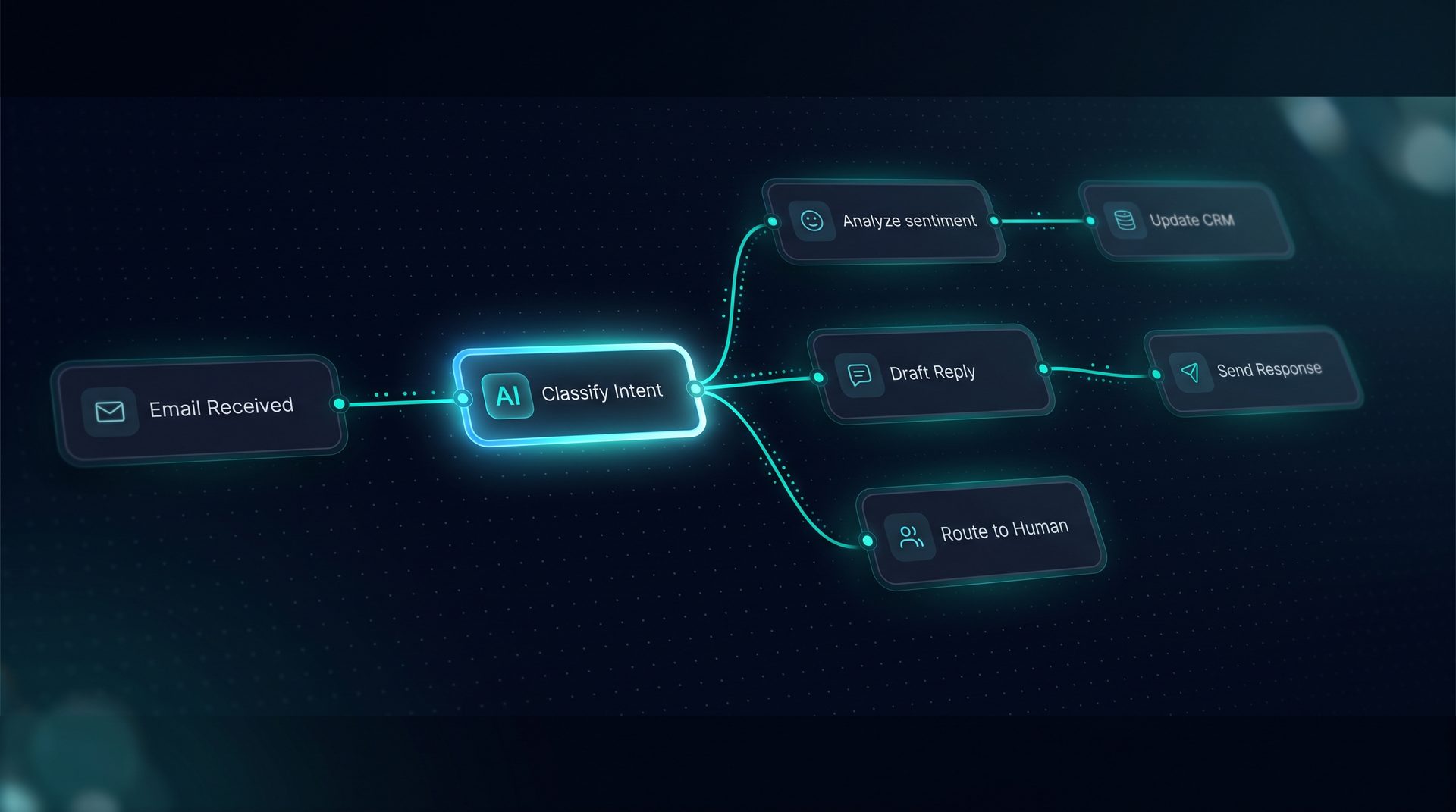
Customer Support Router (ai automation examples for routing)
Trigger: Incoming customer message via chat, email, or form.
Intent and output: Classify intent, extract key entities, propose routing (self-service, specialist queue, escalation), and populate a draft response or suggested KB links.
Tools and integrations: Intent classifier, entity extractor, knowledge base search, CRM and routing API, and optional response-generation model.
Human review point: For escalation candidates or high-risk customer messages, require human confirmation before routing or sending responses.
Failure modes and mitigations:
- Misclassification leading to wrong routing: implement a confidence threshold and fallback to human triage when below threshold.
- Repetitive wrong suggestions from model drift: monitor accuracy metrics and retrain periodically using corrected examples.
This agent pattern reduces first-touch time and routes more queries correctly while ensuring human oversight for ambiguous or sensitive cases.
Automated Access Provisioning Agent (ai agent architecture for operations)
Trigger: Approved access request or role change event.
Intent and output: Determine required permissions, create provisioning tasks, and either provision or prepare an approval workflow.
Tools and integrations: Policy engine, identity management APIs, role mapping database, and audit logging.
Human review point: High-privilege permissions should require human approval; the agent can suggest least-privilege mappings but not bypass approval.
Failure modes and mitigations:
- Over-privileging due to ambiguous role mapping: present explicit diffs and require approval for elevated changes.
- Stale policy data causing incorrect mapping: surface policy version and last update date, and include an easy path to rollback.
This ai agent example emphasizes safety and traceability in ai for it operations.
Continuous Compliance Auditor (ai automation examples for governance)
Trigger: Scheduled scans or configuration changes.
Intent and output: Evaluate current state against policy checks, generate exception candidates, and prepare remediation tickets.
Tools and integrations: Configuration inventory, policy rule engine, ticketing system, and reporting dashboards.
Human review point: Exceptions and remediation plans should be validated by compliance teams before closing items.
Failure modes and mitigations:
- False positives from noisy configurations: tune rules, provide explainable evidence for each finding, and allow bulk acknowledgment with audit trail.
- Missed drift due to partial inventory: ensure agent integrates with multiple canonical inventory sources.
This agent keeps compliance checks continuous while ensuring human validation for uncertain cases.
Assistant That Orchestrates Multi-Step Tasks (agent based ai for workflows)
Trigger: High-level task request such as "prepare weekly ops report" or a conversational prompt.
Intent and output: Break down the task into sub-tasks, allocate tools for data fetch, analysis, visualization, and assemble deliverables.
Tools and integrations: Planner component that reasons about steps, connectors to data sources, lightweight code execution environment for analysis, and export/publishing APIs.
Human review point: Review final deliverable and approve distributions; humans should review any code or data transformations.
Failure modes and mitigations:
- Incorrect orchestration order: include dependency verification and a dry-run mode.
- Silent data errors: require small-sample checks and visibility into transformations.
This pattern is valuable where multi-system coordination is required and the agent reduces manual orchestration.
Comparing Patterns: tradeoffs and selection guidance
When choosing among these ai agents examples, consider three axes:
- Risk tolerance: Higher-risk actions (provisioning, automatic remediation) need stronger human review points and more conservative ai agent architecture.
- Latency needs: Real-time routing agents must optimize for speed and have robust fallbacks; research summarizers can be more relaxed about turnaround.
- Observability and auditability: Agents that change state (provisioning, remediation) should produce verifiable logs and clear evidence for each recommendation.
Practical steps to evaluate fit:
- Map the trigger frequency and peak load.
- Define the minimal safe action set the agent may take without human approval.
- Build transparent confidence and explainability surfaces so reviewers can validate decisions quickly.
Important to know: Results from any ai agent example can vary by data freshness, model updates, and integration quality. Outcomes may change over time and human oversight is recommended for critical decisions.
Implementing an ai agent architecture: pragmatic checklist
- Define trigger and guardrails before building.
- Choose connectors and ensure canonical data sources.
- Implement clear human review points and escalation paths.
- Log all decisions and surface confidence and provenance with each recommendation.
- Monitor drift and establish retraining or update cadence.
Conclusion
These ai agents examples illustrate concrete, pattern-oriented templates you can adapt. Each ai agent example above emphasizes a clear trigger, the likely toolset, an explicit human review point, and predictable failure modes. Use the tradeoffs guidance and checklist to match a pattern to your needs, especially when planning ai for it operations or broader ai use cases. With careful design of an ai agent architecture and attention to observability and human-in-the-loop checkpoints, these patterns can be integrated responsibly into operational workflows.