Agentic AI
Agentic ai is a term used to describe systems that take goal-directed actions over time with some degree of decision-making autonomy. This page defines agentic ai in plain language, explains how an ai agent or autonomous agent differs from rules-based automation and stateless chatbots, and walks through concrete ai agents examples, typical architectures, and when agent based ai is useful or overkill. The primary intent is educational: to clarify capabilities, tradeoffs, and real-world implications for planners and engineers.
What "Agentic AI" Means In Practice
Agentic ai describes systems that can:
- Interpret a high-level objective and generate a sequence of actions toward that objective.
- Monitor outcomes and revise plans when results differ from expectations.
- Use tools, external APIs, or internal modules to gather information and act.
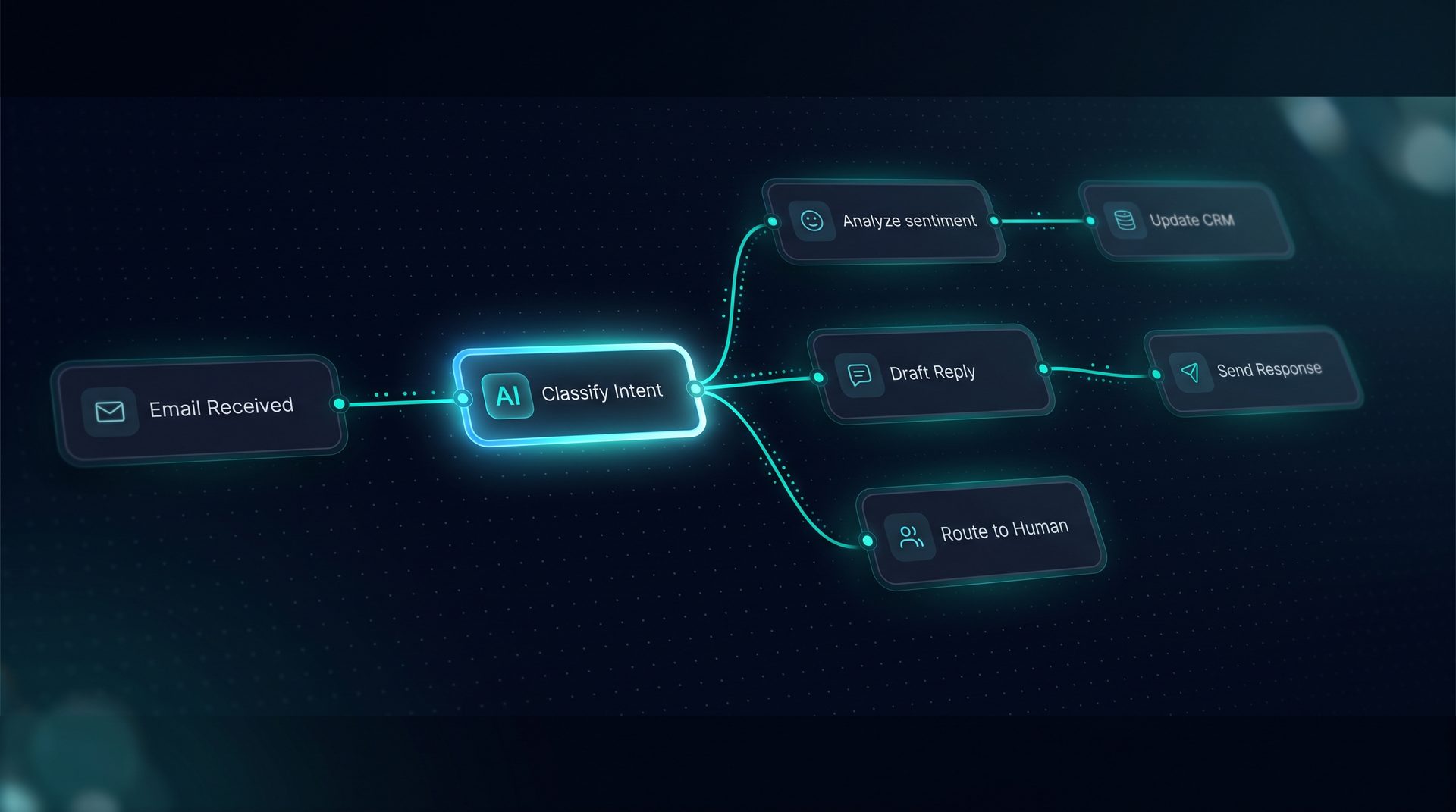
An agentic ai system usually packages decision making, state management, and action execution into an entity commonly called an ai agent or autonomous agent. Unlike a single-turn chatbot, an agent maintains context across steps and reasons about how future steps will affect the goal.
Key attributes of agentic ai
- Goal orientation: the system operates to achieve a specified goal rather than only respond to prompts.
- Statefulness: it persists internal state or memory across interactions and time.
- Actionability: it issues actions, which can be API calls, database updates, or human-facing messages.
- Planning and replanning: it forms plans and revises them when new information arrives.
Important to know: agentic ai systems can vary in how much autonomy they exercise; capabilities and outcomes may differ between implementations and use cases.
How Agentic AI Differs From Rules Automation
Rules automation follows explicit conditional logic: when X happens, do Y. This works well for predictable, well-defined workflows but struggles with ambiguity or open-ended objectives.
Comparative points:
- Decision source: rules automation uses predefined rules; agentic ai reasons and often uses probabilistic models to choose actions.
- Flexibility: agent based ai can generalize across similar tasks; rule systems need added rules for new cases.
- Error handling: rule systems fail when unhandled cases appear; an autonomous agent can detect failures and attempt recovery or escalate.
Example: a rules automation pipeline routes invoices with specific formats to a particular queue. An ai agent could inspect unfamiliar invoices, query a knowledge base, try multiple parsing strategies, and ask a human only when confidence is low.
When to prefer rules automation
- Tasks are deterministic and low-variance.
- Regulatory requirements demand auditable, constrained behavior.
- Simplicity and predictability are higher priorities than flexibility.
When agentic ai is preferable
- Objectives are open-ended or require multi-step problem solving.
- The system must interact with many tools and adapt to changing conditions.
- Human oversight can be combined with automated decision-making.
How Agentic AI Differs From Chatbots
Stateless chatbots answer prompts without sustaining long-term plans or actively executing external actions. They are optimized for conversational turn-taking, not long sequences of goal-directed behavior.
Distinct differences:
- Chat context: chatbots may keep session context but rarely maintain durable task state across sessions; ai agents keep task-focused state across multiple steps.
- Action execution: chatbots typically generate responses; agentic ai issues and manages actions against external systems.
- Planning scope: chatbots respond locally to a message; autonomous agents plan over a horizon and sequence multiple tool uses.
Example: a customer support chatbot answers a billing question in a single session. An ai agent could handle a complaint end-to-end: gather evidence, open tickets, communicate with other services, and hand off to a human when needed.
Typical Architecture Patterns for Autonomous Agents
Agentic ai implementations vary, but common components include:
- Goal interpreter: maps a human instruction or objective into structured subtasks.
- Planner: creates a sequence of actions, possibly using search or learned heuristics.
- Executor / action manager: runs tool calls, API requests, and other operations.
- Memory / state store: records past observations, decisions, and intermediate data.
- Monitor / replanner: evaluates outcomes and alters the plan if necessary.
- Safety and guardrails: constraint modules that prevent unsafe actions or escalate to humans.
Architectures can be synchronous or event-driven, centralized or distributed, and may incorporate multiple specialized ai agents collaborating on a single objective.
Common Agent Types And ai agents examples
- Retrieval-enabled agents that research topics by querying indexed corpora and synthesizing answers.
- Workflow agents that coordinate multi-step business processes across systems.
- Test automation agents that design, run, and triage tests by inspecting logs and altering test plans.
- Data pipeline agents that monitor data quality, trigger repairs, and adapt transforms.
These ai agents examples illustrate how autonomous agents in ai move beyond responding to prompts and instead orchestrate multi-tool, multi-step work.
Tradeoffs And Failure Modes
Agentic ai brings new capabilities but also new risks and costs.
Pros:
- Can handle complexity and ambiguity.
- Reduces repetitive manual coordination where goals are clear.
- Can discover novel sequences of actions that a static rule set would miss.
Cons and risks:
- Harder to verify and audit than deterministic automation.
- May take suboptimal or unexpected actions if objectives are poorly specified.
- Requires careful safety constraints to avoid cascading errors.
Common failure modes:
- Overconfidence in uncertain outputs from external tools.
- State drift where accumulated memory leads to incorrect assumptions.
- Tool misuse when the agent selects inappropriate APIs or parameters.
Notes: outcomes can vary by implementation and context; agentic ai may succeed in one environment and struggle in another depending on data quality, tool reliability, and oversight.
Designing Effective Agentic Workflows
Practical guidelines:
- Start with a clear, measurable objective for the ai agent or autonomous agent.
- Define allowed tools and establish safety constraints.
- Provide mechanisms for human review at critical decision points.
- Track provenance: store why actions were chosen and what evidence supported them.
- Iterate on reward or evaluation signals to guide planner behavior.
Checklist for deployment readiness:
- Test on representative edge cases.
- Deploy monitoring to detect regressions or unsafe patterns.
- Implement escalation paths for human intervention.
When Agentic AI Is Overkill
Agent based ai is not always the right solution. Consider simpler options when:
- The task is a straightforward transformation or routing problem where rule logic suffices.
- Regulatory or auditing needs demand fully explainable, deterministic behavior.
- The overhead of state management, planning, and monitoring outweighs the benefit.
Choosing the appropriate approach conserves engineering effort and reduces operational risk.
Conclusion
Agentic ai and autonomous agents in ai introduce goal-directed, stateful, and actionable behavior that differs substantially from rules automation and stateless chatbots. Understanding the tradeoffs, architecture patterns, and where to apply agent automation helps teams make informed decisions about adopting agent based ai. When designed with safety, monitoring, and clear objectives, ai agents can extend automation into more complex domains; when misapplied, they can add unnecessary complexity and operational risk.